

Kaitlyn Cimino / Android Authority
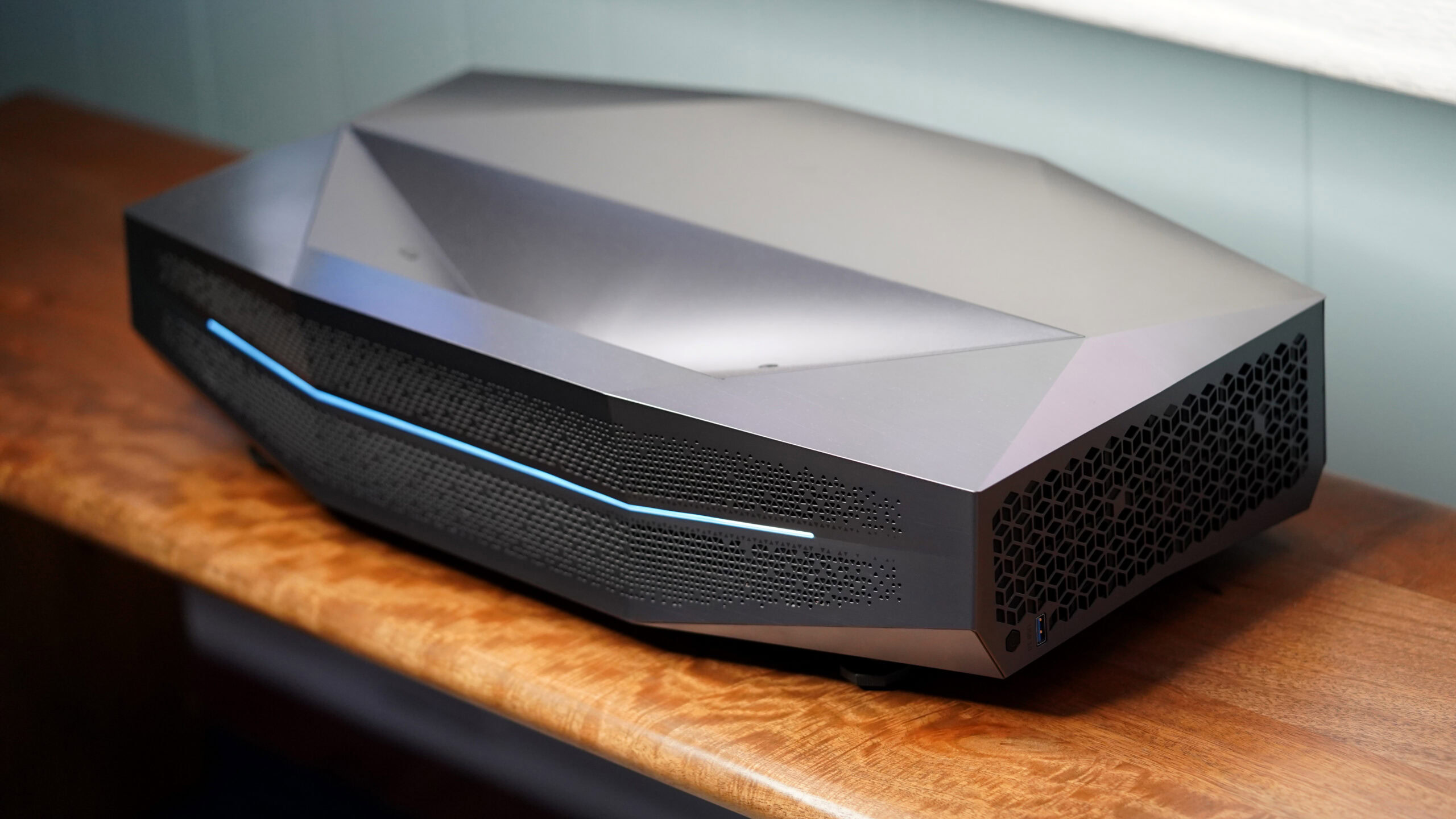
After months of testing projectors, ultra-short-throw (UST) models keep winning me over. They smooth out a lot of everyday annoyances without sacrificing the cinematic feel I’m after for movie nights. At this point, buying one feels inevitable.
Are you purchase an ultra-short-throw projector?
3 votes
Setup stays simple

Kaitlyn Cimino / Android Authority
There’s a lot of impressive projector hardware available, but I don’t love the idea of permanently mounting something overhead in a room that isn’t a dedicated theater. A UST projector sits just inches from the wall, which means I can get a 100-inch-plus image without drilling into the ceiling or rearranging furniture around a throw-distance chart.
Most UST models achieve cinema-worthy screenings from well under a foot away thanks to extremely short throw ratios, often around 0.2:1. It still requires thoughtful placement, but the setup feels far more approachable. Add in universal features like auto focus and geometric correction, and it’s easier than ever to get a clean image.
It can seamlessly replace my TV
A UST projector would live where my TV currently sits, which means I wouldn’t have to change a thing about my living room to swap one out for the other. Because the projector sits on furniture instead of the ceiling, the whole setup can disappear when it’s off. Some brands even sell consoles designed to hide the projector and tuck away retractable screens, so your living room doesn’t have to look like a home theater 24/7.
Many newer models also ship with Google TV or similar platforms, multiple HDMI ports, and TV-style remotes, which makes the transition feel surprisingly seamless.
The cable situation is blissful

Kaitlyn Cimino / Android Authority
Traditional projectors require planning. Setting one up often involves a cable raceway that never looks as subtle as I’d hope. A UST parked on a media console sits close to power, with a dedicated landing space for accessories like a soundbar or a gaming system. Everything connects in one manageable zone instead of spiderwebbing across my living room.
I don’t need a big room, just one good wall

Kaitlyn Cimino / Android Authority
Long-throw projectors force you to think about distance first, which can make smaller living rooms feel limited before you even start unboxing. With a UST projector, all I need is one ample wall to get a massive image without encroaching on the rest of the room. If I want to shrink the image, I can simply move the projector even closer to the wall.
It still delivers the cinematic punch

Kaitlyn Cimino / Android Authority
All the practicality wouldn’t matter if the experience felt like a compromise, but that’s what surprised me most. Screen sizes in the 100- to 150-inch range are common, and that scale changes how movies, sports, and even casual TV feel. Laser light engines, higher brightness ratings, and support for formats like Dolby Vision all help keep that size feeling immersive.
Don’t want to miss the best from Android Authority?


No one is constantly walking through the picture

Kaitlyn Cimino / Android Authority
With traditional projectors, the beam runs across the room, which means someone eventually stands up, grabs a snack, or walks past and throws a giant shadow on the wall. Because a UST projects from just inches away, the light stays tight to the wall instead of cutting across the living room, and my movie stays uninterrupted. That steep projection angle is one of the biggest practical differences between UST and long-throw models. Theoretically, it should mean I’m less likely to accidentally look right into the laser, but only time will tell.
Thank you for being part of our community. Read our Comment Policy before posting.
 By
By