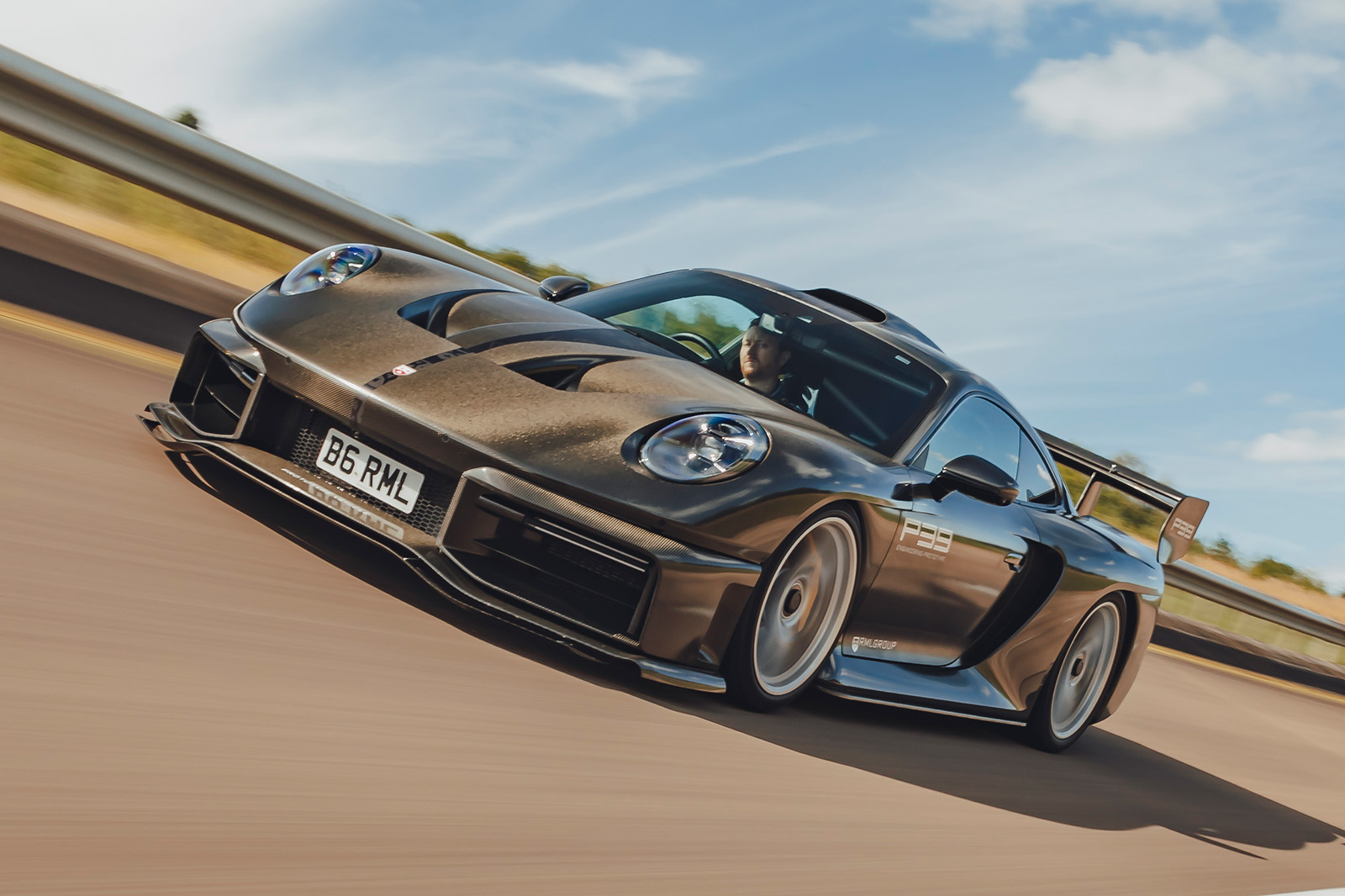

The GT Hybrid had to look totally spectacular, too. Obviously. Getting rear arches positioned just so relative to the long-tail body meant extending the underlying 992 wheelbase by 100mm via the suspension.
The tracks are also wider. Quite a lot wider, in fact – more than a wheel offset. It has necessitated new, elongated suspension links, which are beautifully machined, with geometry designed to retain the functionality of the Turbo S’s active anti-roll bars and rear-axle steering. Remapping these systems was not really an option, says Mallock.
To illustrate the complexity of modern cars, he tells me that when they swapped the seat from a 911 into a Taycan for materials testing, the radar and left window stopped working. As such, in its former life as a standard Turbo S, this prototype often carried dataloggers so RML could understand the detail of the sub-systems, and ensure the GT Hybrid’s suspension movements would be compatible.
While the fundamental kinematics of the donor car are thus largely unchanged, including the roll centres, the new lower wishbones do have camber shims for easy adjustment trackside.
Against all this, the small matter of 907bhp feels like a footnote. Hell of a footnote. Litchfield has done the work on Porsche’s 3.7-litre twinturbo motor, and after RML has stripped the donor car, the chassis heads west to Gloucestershire to have its heart put on anabolic steroids. The stock engine is robust enough that the internals need not be changed.
It’s more a question of “keeping the engine happy”, as Iain Litchfield puts it, with a surfeit of cooling, not least from uprated dual intercoolers. The uplift in power from the regular 641bhp of the Turbo S is also the result of a new electronic calibration and new turbochargers whose turbines are 6mm or so wider in diameter. This doesn’t punt up the turbo lag because it’s balanced out by the ram-air effect of the new intake and freer-flowing filters.
All this kit can be stuffed into the engine bay because RML’s long body takes the sting out of packaging constraints. The P39 has the largest catalytic converters on the market, as well as a full inconel exhaust smothered in F1-grade heat shielding. In RML’s workshops, the huge intake tracts – two polished carbonfibre anacondas curling down to each side of the intercoolers – are on full display.
 By
By