
Written by and Photos by Liam Parkin. Posted in Rides
On the edge of the Sahara sits Marrakech, a gateway city surrounded by mountains, spanning the end and beginning of two worlds, where West African and Saharan cultures blend with the traditions of their North African neighbors.
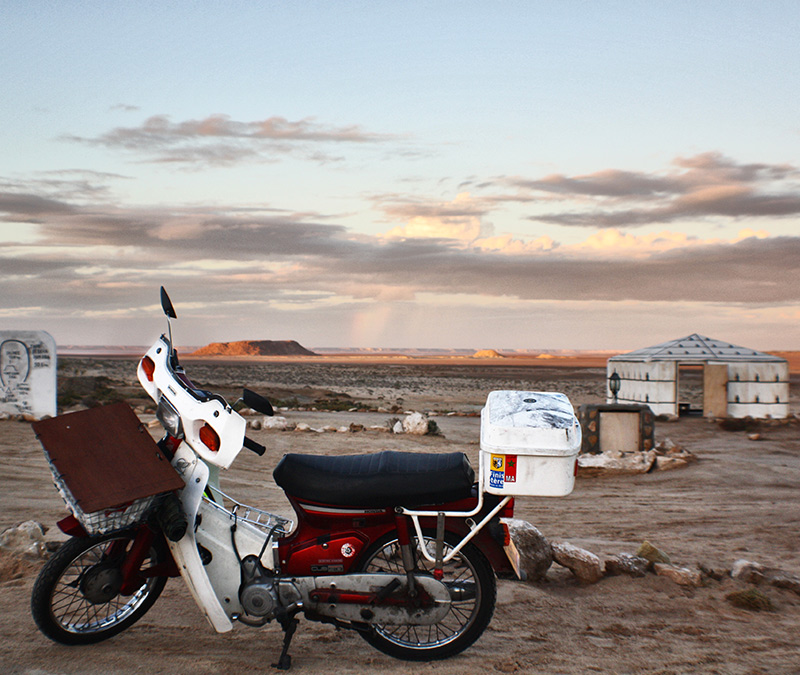
I rode from England to Marrakech on a 24-year-old moped, a Honda C90. It took two and a half months and it felt like a milestone to arrive in Marrakech—the last hub of familiar culture, where things seemed exotic and easy, yet a place where I could still easily meet fellow Europeans. My girlfriend had flown in for a week, adding to my sense of comfort before I ventured out into the sands of the great unknown to ride across the Sahara.
My anxiety had been building in the month before I attempted to traverse the desert. I thought about breakdowns, water shortages, running out of petrol, miles of solitude, and Saharan jihadists. I tried unsuccessfully to find travel partners. When the time came for my girlfriend to return to England, the last time I would see her for the better part of a year, I experienced one of the loneliest moments of my life.
Alone, riddled with doubt and fear, sitting on the bed where we’d nested over the previous week, my heart felt raw now that my love was gone. I sat there, lonesome beyond anything I’d known before, about to ride further into my fear.
On the second day after leaving Marrakech, I arrived at the edge of the desert—a land called Hammada, a barren and seemingly endless plain of rocks and sand where the dwindling Atlas Mountains further diminish as the road stretches out of sight. Vehicles became scarcer, as did people and dwellings, yet as human presence vanished, the forces of nature became more dominant.
As my wheels slowly put the miles behind me, the wind picked up. The locals call the wind “Sirocco,” and I quickly understood why it was looked upon as something that deserved a name. It transforms the landscape.
The scarce plant life there is bent and contorted, and the mountains on either side of the road are carved to the point where you can see the layers of time etched into the rock, almost as if they were living things. By no means are they as big as the Atlas range before them, but in this barren landscape they are omnipresent.
Riding through Hammada, I pulled over to the side of the road for one of my frequent stretches. A man started waving from a distance—maybe a kilometer away, so I waited for him to come over. He was a goat herder, wearing simple clothes and a black turban. He asked if I had run out of petrol. Although we couldn’t speak each other’s language it’s amazing how far we got with gestures.
Eventually, he invited me to his home for food and tea. Not wanting to pass up my first chance at human interaction since Marrakech, I accepted. He pointed to a track I could ride while he ran over the sand. About two miles out we arrived at his makeshift home. It was very basic living, a wooden bed with a few sheets, bare walls, empty space and a rug. Around it were animal lodgings where he showed me, with considerable joy, his two newborn baby goats.
Over a fire he started from scratch in about twenty seconds, he made a mint and very sugary tea in a tiny kettle. We then ate a stew that he’d made earlier. I had to show through gesturing that I was too full so he wouldn’t offer it all to me.
When the time came for my new friend to return to his goats, he gave me a parting hug, a customary kiss on each cheek, and then ran back over the sands to his livelihood. I rode away from that moment with a newfound sense of why I was doing this. Acts of hospitality like this remain some of the kindest things strangers have ever done for me.
Within a few days, I’d officially crossed into the Western Sahara. I’m not sure if “officially” is the correct term, as borders in this part of the world are heavily disputed. It’s clear that Morocco is winning. Moroccan Dirham is the currency, and a vast number of Moroccan military and police, as well as a substantial NATO presence, are evident.
Sadly, one of the pitfalls of this territorial dispute is that the area is now one of the most heavily mined places on earth. And one of the many desert wonders, along with the mirages and whistling wind, is that the dunes shift. Of course, this means that the mines drift, too—a fact I didn’t take lightly when searching out a place to camp.
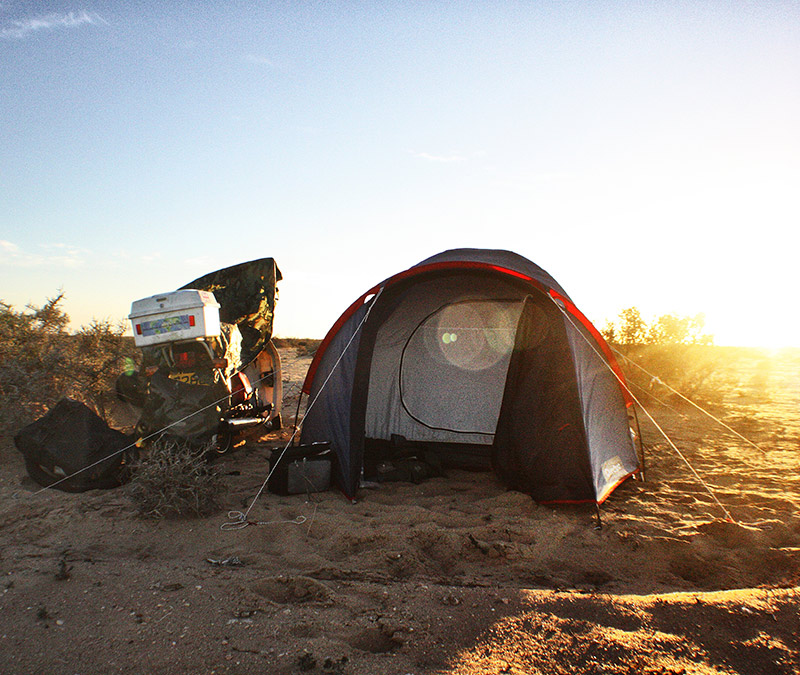
Aside from dodging mines, finding places to stay in the sand turned out to be one of my favorite things while crossing the desert. After hours on the windy road, combating blasting sand while trying to keep the bike upright, it was a delight to find quiet places. As the wind settled down most evenings, I was free to take off most of my clothes to set up camp.
Detaching myself from the riding gear, I’d lay on the sand, watching the sky as blue turned to pink, orange and then a deepening purple, pierced with tiny, bright specks. Those sunsets were treasured moments, and I was content, lying there on my own.
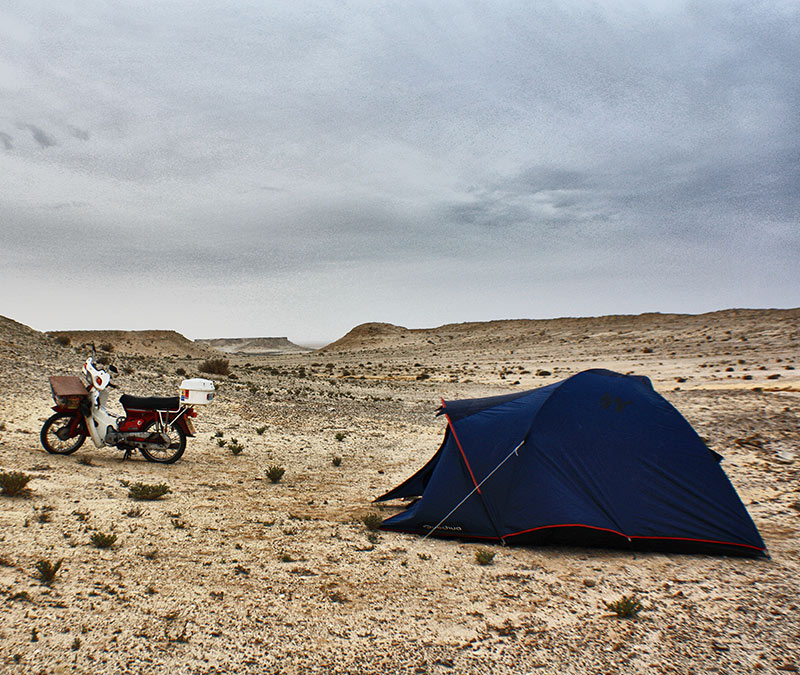
I looked over to my bike, standing beside the tent without complaint. It was a precious thing to me and had become my friend. I couldn’t believe its tiny engine and wheels had brought me to this place. It was the object of freedom—we were now on the journey. I had found the joy that I had been searching for, the joy of solo travel on my own two wheels.
Originally, when I imagined crossing the Sahara, I envisaged pulsing heat and a ferocious and blinding sun, causing the landscape to evaporate before me. The latter was true to some extent, but ironically, as it was winter, the Sahara was one of the wettest places of the journey so far.
One night, as I camped on the edge of a cliff overlooking the Atlantic Ocean, I sat for hours watching a lightning storm far out at sea, amidst the dotted lights of a few distant boats. The bright bolts carried no sound as they shot into the once black, then illuminated water. Just as I settled into bed the storm began to descend on me. The lightning became brighter, and the thunder roared closer until it was above me.
The wind and rain came hard and fast. Against their driving forces I had to brace the bending tent poles. The rain soaked my sleeping bag and I barely slept that night. In the morning I packed everything away in the rain and rode away from the cliff covered in mud. Definitely not one of the scenarios I had imagined.
Within a few days I came to the end of the Western Sahara, reaching my first true African frontier—the Mauritanian border. I had read that the road leading to the border was notorious for banditry and the scene of a recent Al Qaeda kidnapping—although I didn’t remember this until I arrived at the campground in Nouadhibou that evening. Fear seemed to have left me.
The no man’s land, a three-mile stretch that’s totally unpaved and ignored by both countries, was a startling reminder of how far away from home and culture I’d come. Yet, it’s home to a large number of people—West African refugees who were denied access to the Western Sahara and can’t get back to Mauritania. They eke out their living by any means they can, on land that’s essentially a minefield.
It had taken thirteen days to reach Nouadhibou from Marrakech. For me, Nouadhibou signified the end of my solo trek across the Sahara. On my second day there, which also happened to be my birthday, I met up with other travelers, ceasing my solo travel for the time being.
My time crossing the Sahara on my own, where every decision I made formed the path in front of me, marks one of the pinnacles and definitive moments of my journey. It’s a place I look back to when times get difficult. It has inspired me to travel alone again; without fear, without doubt, with the pure exhilaration of just me on my bike, with the conveyor belt of the world flowing under my two wheels.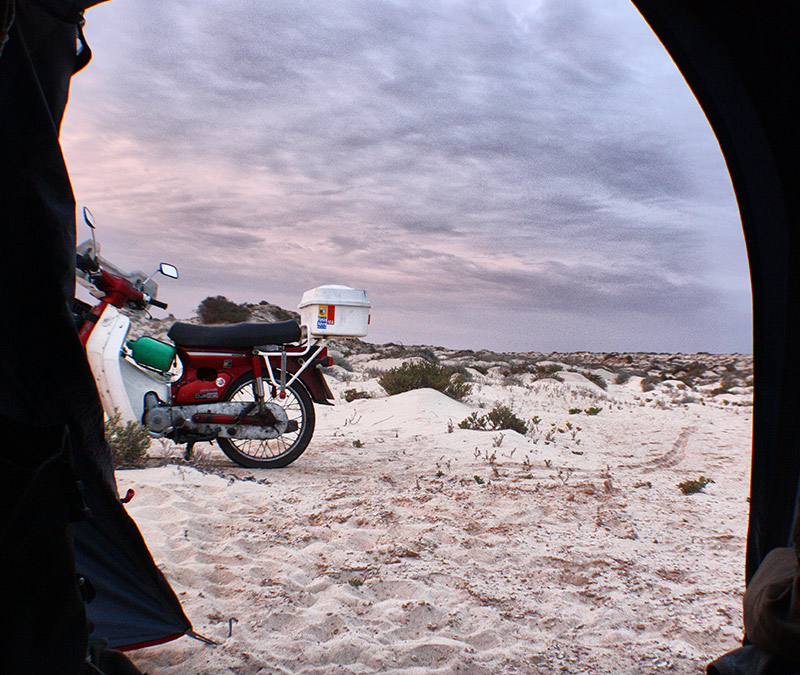
Liam Parkin was born into a family of travelers in a small country town in the North of England. Taught from a young age that travel is the best education, after completing a fine art degree at Manchester Metropolitan University, Liam set off to traverse the Earth on his Honda C90.
 By
By