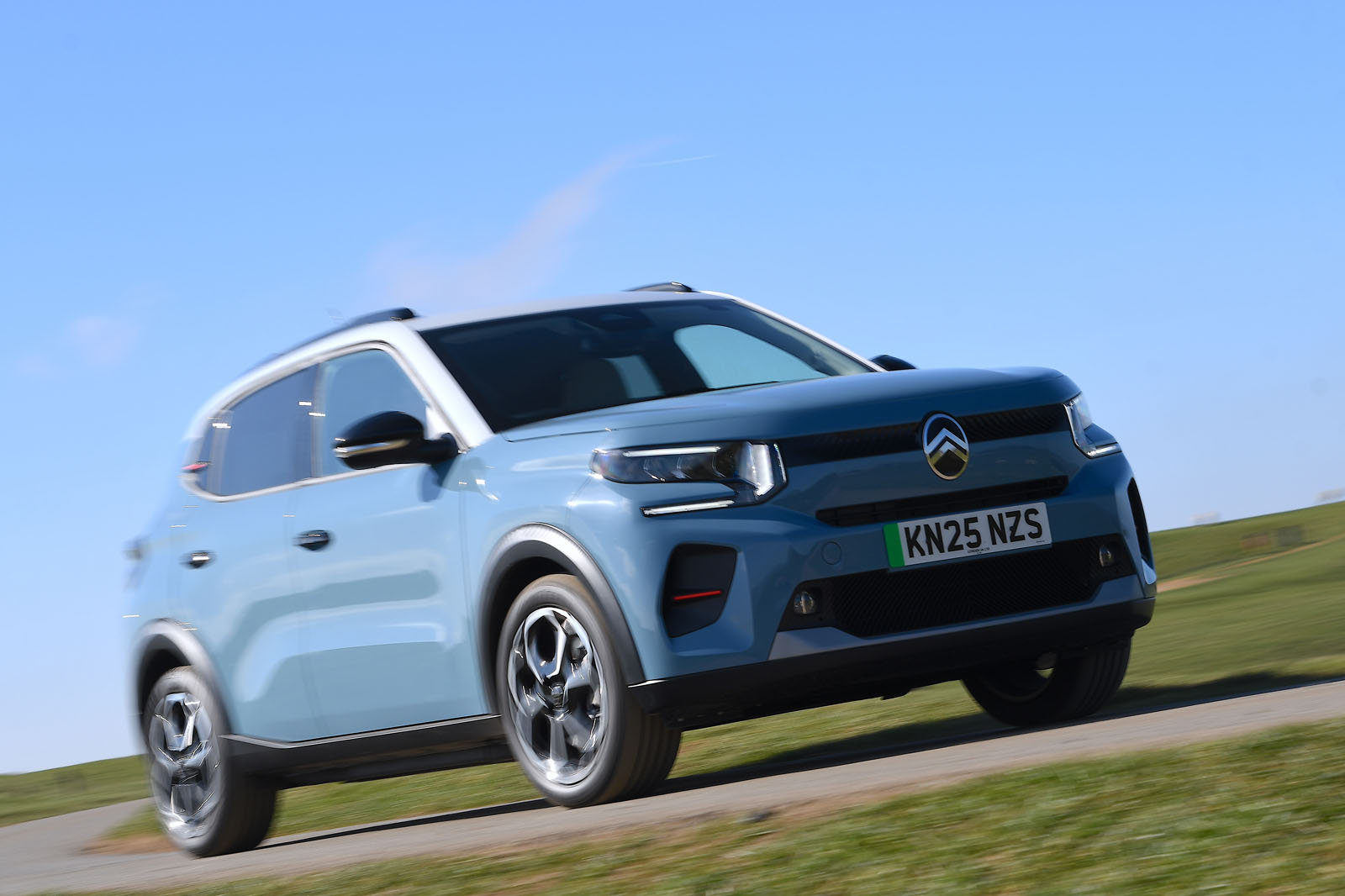

There is some practical sense in allowing the C3 to grow five inches taller. An upwards stretch doesn’t affect how much space this car takes up at the kerb, and it allows Citroën to offset the impact on cabin packaging of an underfloor battery pack and also to give occupants more outright space by sitting them less recumbently than they would otherwise be.
Thus the ë-C3 becomes quite a spacious-feeling supermini, one with particularly abundant head room in the front row and enough space in the second row for most adults to be fairly comfortable.
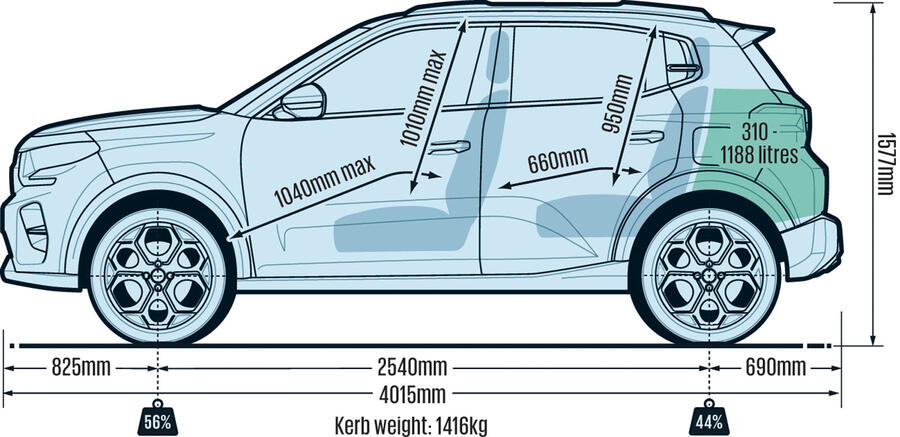
We measured 1010mm of front-row head room (20mm more than in the Toyota Yaris) and 660mm of second-row leg room (Toyota Yaris 630mm, Nissan Micra 640mm). The car’s seat cushions lack a little useful inclination angle but, while there’s some compromise to longer-distance comfort in the back due to the highish cabin floor, the seats in the front are comfortably padded and are moderately adjustable.
The ë-C3’s driving position feels a little like one borrowed from sister brand Peugeot’s i-Cockpit playbook. The steering wheel is small and the column low-sprouting, while the all-digital instrumentation pod sits high on the fascia right at the base of the windscreen.
The primary control layout works reasonably well. The space it liberates on the full-width, double-tier dashboard itself makes for lots of oddment storage, and the little corners and flat surfaces can be decorated with colourful knick-knacks, should you be so inclined.
Multimedia – 3 stars
The ë-C3’s provision of physical heating and ventilation controls, mirror adjusters and even proper buttons for the deactivation of key ADAS functions shows you how much Citroën appreciates simplicity and usability.
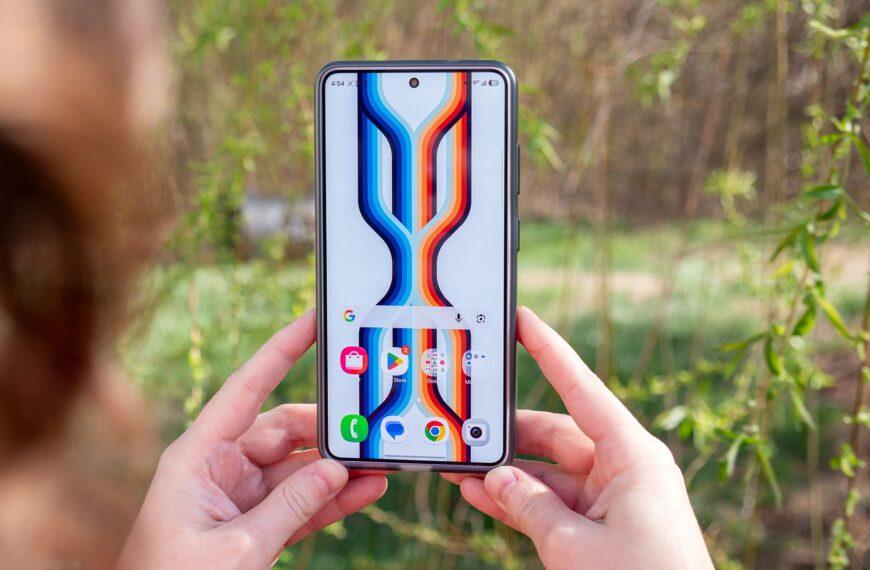
The studious simplicity of the 10.3in touchscreen infotainment system might actually be a little too much. It offers no trip computer functionality, for instance, and no way to toggle the electronic traction or stability controls; nor even any option to switch the factory navigation system’s units of measurement from metric to imperial (our test car’s was stuck on the former).
Wireless smartphone mirroring is standard on both Plus and Max models, though, and our experience suggests that’s what you will use. And, more widely, the display isn’t too distracting, mostly because the system’s remit is quite limited.
 By
By