
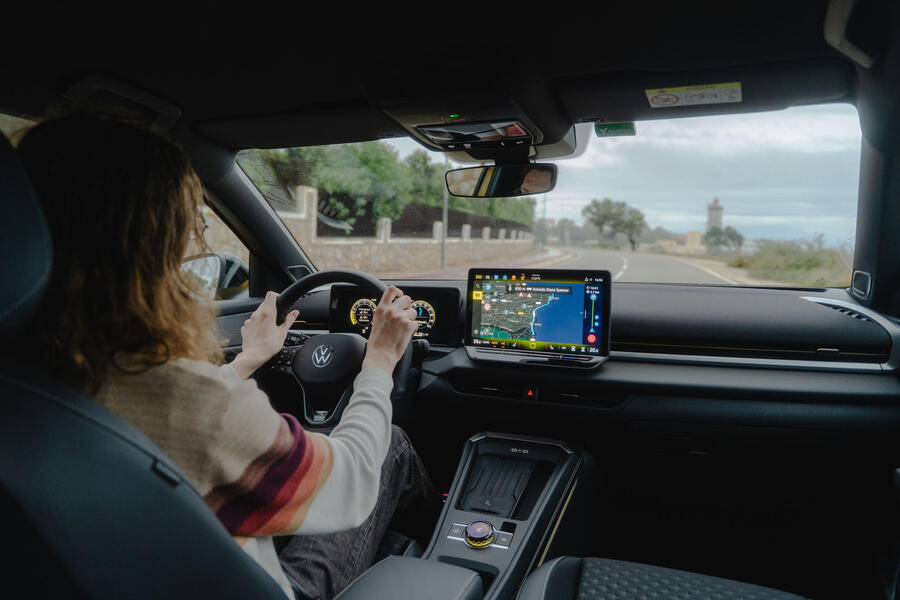
Even more than in the chassis, a Diess-orcism has been performed on the cabin. Even though the T-Roc sits below the Tiguan, it feels a bit more premium. There are new door handles, which you pull up rather than out, and the materials feel like an upgrade, including next to no gloss-black plastic. The silvery strip around the dashboard and the Mini-style knitted fabric on the dash add a bit of visual interest, and on the higher-spec versions there are pieces of perforated leatherette on the doors that let the ambient light through – a neat touch.
The much-maligned touch bar makes another appearance, but I don’t mind it. It lights up, you tap the red bit to make the air warmer, the blue bit for colder – plus it’s joined by a multi-functional rotary knob that does the volume and drive modes. It’s all pretty intuitive, if not quite as good as the original T-Roc’s more fulsome array of buttons.
As usual with Volkswagens but unusually for the class, there’s a wide array of seat options. The basic ones lack some thigh support but do feature adjustable lumbar support; the upgraded ones are superb.
Knee room is just about sufficient for me, at a long-legged 6ft 2in, to sit behind my driving position, and the rear seat angle is quite comfortable. At 475 litres with some extra space under the floor, the boot is a good size for a compact crossover too.
Infotainment is the usual Volkswagen deal. The touchscreen is bigger and more distracting than it needs to be, but the menu layout is very configurable, it responds pretty quickly, most of the major functions are just one tap away and there’s wireless phone mirroring.
 By
By