
Written by James Carlisle. Posted in Rides
Almost three years in the making, this trip started after seeing a photograph of a Royal Enfield Himalayan high in the Himalayas, whereupon my friends, Nash and Ladd, and I went to work planning the trip and making contacts. Royal Enfield recommended Vintage Rides (Vintagerides.travel) touring company as the best in the business. Not long after we paid our deposits and began packing our bags. That was in February of 2020, a month before COVID hit. As a result, we rescheduled and rescheduled again until June 2022. And so, it began…
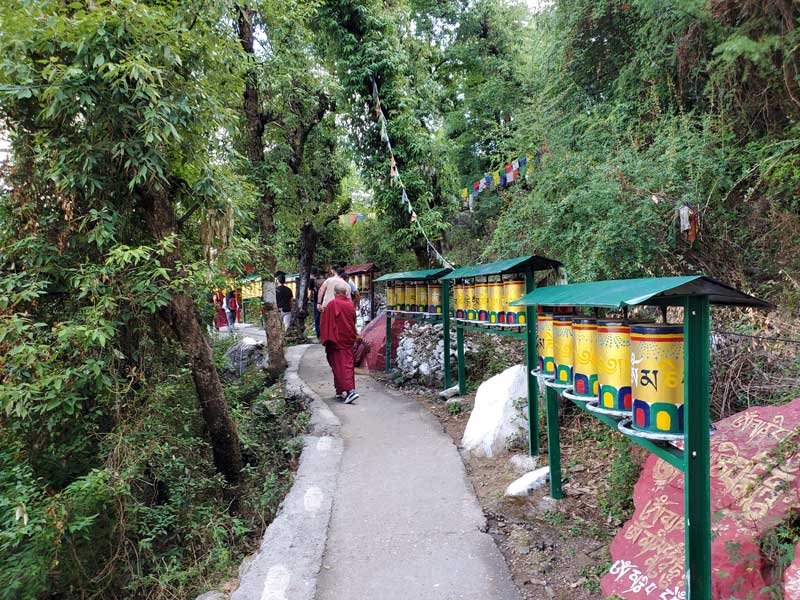
Day One and Two: In Dharmsala, India, we picked up the Royal Enfield Himalayans. From there we rode into the mountains near the home of the Dalai Lama where we walked among the Tibetan monks in the land of an exiled people. At 5,280 feet, we were a mile above sea level. Although we quickly acclimated to the rules of the road, our first impression was that we’d meet our doom in the horrific traffic. Yet by the end of the trip, we miraculously never saw a single traffic accident other than witnessing a bus slide off the side of a mountain!
 Each prayer wheel contains thousands of prayes and each person who passes spins them clockwise in Dharmsala. | Photo Credit: Nash Ogden
Day Three: Chamba, India, it rained for half the day, but at least there was less traffic. All roads were single lanes with intermittent stretches of gravel, asphalt, mud, and packed dirt, as well as a recent landslide. Cars, trucks, motorcycles, and scooters worked together to navigate around as efficiently and quickly as possible. Dinner was melt-in-our-mouths tandoori chicken and lamb.
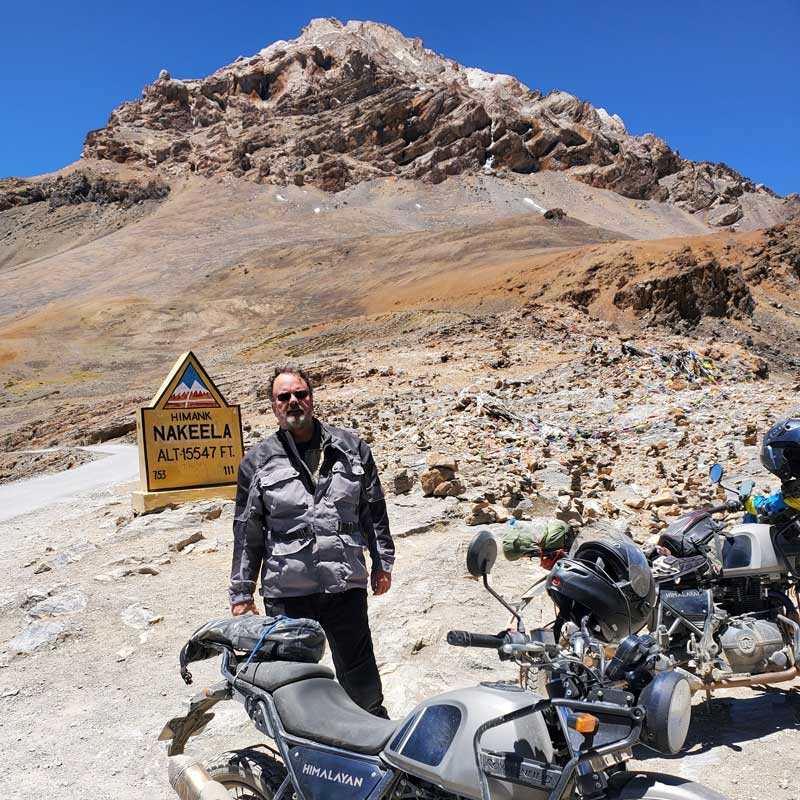 Little did we know we would rarely drop below the altitude of this pass over the next six days. | Photo Credit: Nash Ogden
Day Four: Killar, India, it was raining again as we rode out and continued until a police checkpoint at Sach Pass (14,420 feet) around noon. The pass was snowed in, and the police would not let us attempt it. But an hour later they let us go. Both adventure bikes and cars struggled mightily, and each of us riders fell more than once. At the top of the pass, we were able to forge on once again after a bulldozer cleared the snow. As Neil Peart wrote in Roadshow, “Adventures suck when you’re having them.” This may have been my best day ever on a motorcycle.
 The Americans at the top of Sach Pass. | Photo Credit: Alexandre Bouffett
Day Five: Following the Chenab River to Jispa, home of an ornate 700-year-old wooden temple, we spotted a tiny farming village on the side of the mountain. One of the men was so enamored with Nash that he invited him to his home and gave him a hat made of flowers and vines. After lunch, the roads were mostly paved and much fun.
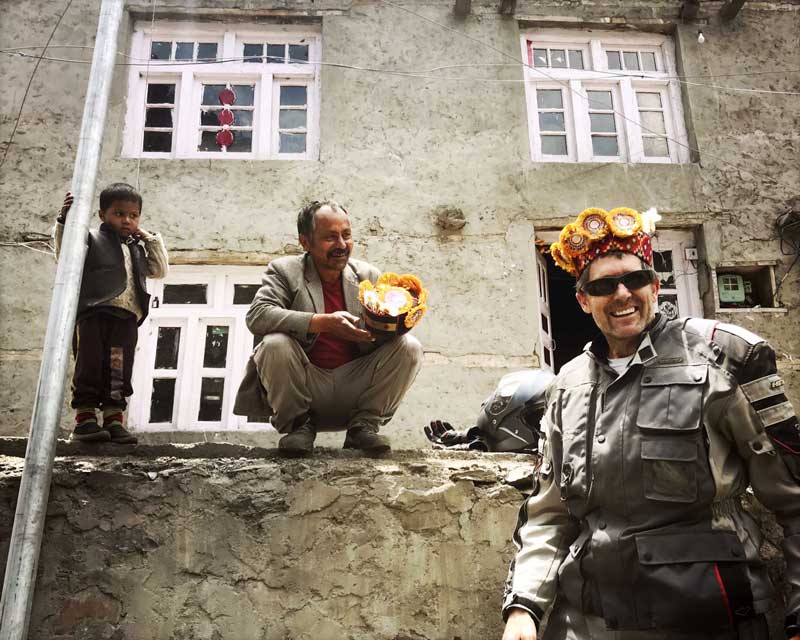 Stopped in a small farming comunity Salgaraon on the way to Jispa where a man insists that Nash recieves a handmade hat. | Photo Credit: Johann Rydes
Day Six: From Tso Kar the roads got dusty and rough, but the people colorful and inviting. We met Francois, who left Paris on his Ducati Scrambler just before COVID and never stopped traveling. He’d met a young lady in Lebanon who decided to buy a motorcycle of her own in Delhi to join him. Another rider, Bhuwan from Bangalore, had been traveling on a BMW 310GS. These bikes stood out against our sea of Royal Enfields. We crossed several passes getting to Baralacha La at 16,298 feet. A first aid kit I’d strapped to my bike came in handy after our tour guide, Johann, hit a boulder tumbled. Lots of sand riding that day—I hate sand! Johann called it fesh-fesh, which reminds me of the grey moon dust I’d encountered in Iraq. We crossed about 12 miles of wide-open flat terrain where there were no roads, just multiple dirt tracks in the general direction we were headed. While our throttles were pinned skipping over rocks, a herd of running wild donkeys approached from the left and ran with us for several miles before eventually peeling away—it was like a dream sequence! Our hotel that night was at 15,000 feet, without electricity, hot water, cell service, or Internet. Bliss for some.
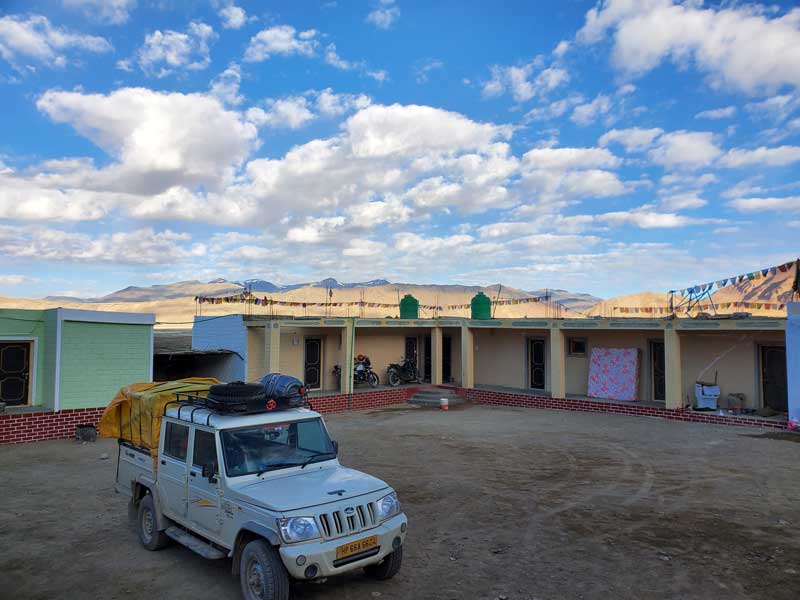 No internet, phone, electricity, or hot water – Bliss for some. | Photo Credit: Nash Ogden
Day Seven: Crossing the Taglangla Pass on the way to Leh, one of the guys came down with terrible altitude sickness and was throwing up. We had no choice but to rush him down the mountain. At 17,582 feet, it’s the second highest pass in the world, made even more spectacular because we had it to ourselves. Descending through a magnificent red rock canyon, we finally arrived at Leh. There we had to change from Himalayans to Bullet 500s as part of an economic agreement that protects the locals and their ability to earn a living through tourism. The hotelier was overjoyed at our arrival as we were the first of the foreign motorcycle tours to return to Leh since COVID began. Throughout history, Leh has always depended on travelers as it was originally a stop along the Silk Road from Punjab to China. You can still see the Chinese influence on the local menu, although we stuck with Indian and Tibetan food for dinner.
 The first two foreign motorcycle tour groups to return to Leh were welcomed heartily. | Photo Credit: Nash Ogden
Day Eight: The day started poorly when I injured my back. I could ride but was in excruciating pain. This was not a new injury, but I usually took strong painkillers and muscle relaxers for a few days to recover. It’s unwise to mix the drugs with motorcycling, so I had to tough it out. Finally, we made it to the “Crown of the World.” At 3.5 miles up (18,379 feet), Khardung La (“La” is “Pass” in the local Lehdak dialect) is touted as the highest motorable road in the world (higher passes, such as Umling La, are currently limited to military traffic due to tensions with China). Snapping a selfie at the top of the pass seems to be the No. 1 attraction in Leh, which is unfortunate because there is so much more to see. Thinksey monastery sits atop a hill overlooking the city swathed in color. The market, with its wide walkways and open spaces, gives a very European feel while preserving the Asian flavor.
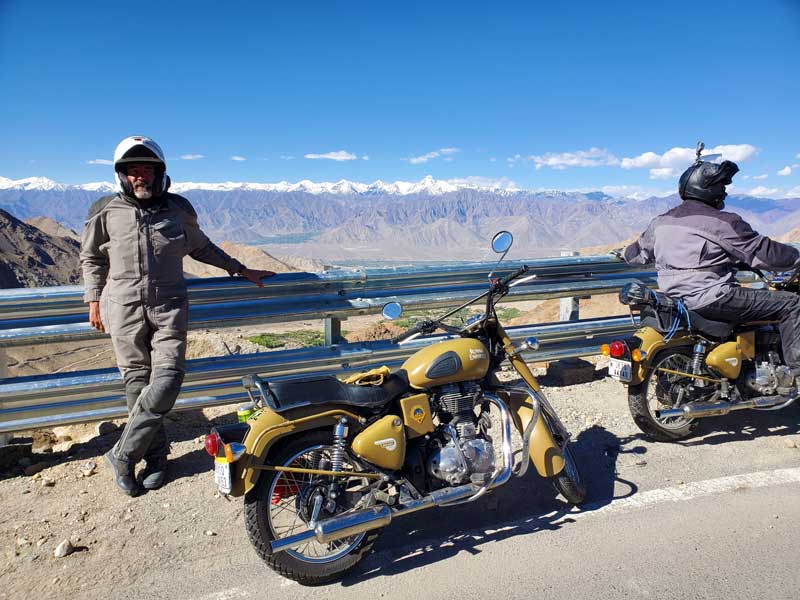 Taking a moment to catch our breath as we head up to Khardung La-the highest motorable road in the world. | Photo Credit: Nash Ogden
Unfortunately, the return trip to Delhi was made dangerous by the traffic heading up to the pass. Prior to this, the folks we shared the road with were considerate and cooperative. But this wave of traffic behaved like they were in a race and oblivious to everyone else on the road (the only time on the bike I felt threatened by traffic). To make matters worse, on the way down, my Bullet 500 died, as did Nash’s. Switching to reserve (the Bullet is carbureted), only Nash’s bike started. Since it was all downhill, we coasted until about a half-mile from the hotel. Nash rode ahead to send the mechanic. Usually, I’m reasonably adept at diagnosing and repairing mechanical issues. Still, I wasn’t in the best of moods between the back pain, the recalcitrant old motorcycle, and the dangerous traffic. The mechanic quickly diagnosed the problem (a blown fuse) and we were on our way again.
Day Nine: After trading the Bullet 500 fleet back for our now beloved Himalayans, we followed the Indus River to Tso Moriri. The terrain changed constantly but remained rugged and mountainous. In that arid range, wherever a little rain has fallen, colors quickly blossom and rapidly fade away. There was a haunting beauty that took my breath away. Tso Moriri is the largest high-altitude lake in India and supports a diverse but sparse ecosystem. The water was brackish but crystal-clear. Nomadic Tibetan herders raise goats in this area to produce fine-quality wool (Pashmina). A 400-year-old Buddhist monastery overlooks the lake and the small town of Karzok, where we stayed in luxury tents. At 15,000 feet, we slept close to the stars on that cold, moonless night.
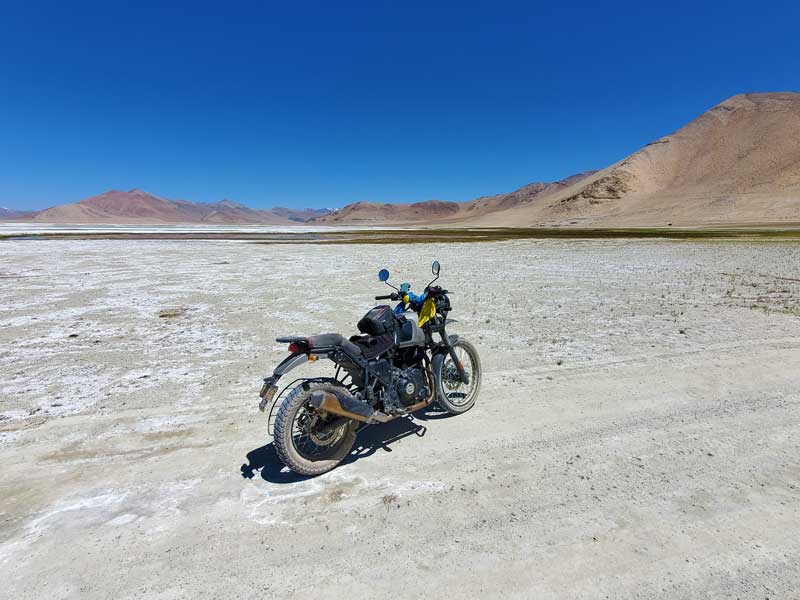 Wide open throttle but the lake and mountains are much farther away than they look. | Photo Credit: Nash Ogden
Day 10: Backtracking a little (conflicts in the regions prevented us from making a loop), and after five hours of mixed off-road and rock-strewn dirt roads, we were thrilled to be back on the smooth two-lane bitumen. Sweeping curves and rolling hills provided a welcome change of pace. And it was big smiles all the way to Sarchu Adventure Camp. It was cold as the sun set, but we were welcomed at the cookhouse where it was warm and full of wonderful fragrances. And the experience gave us a chance to watch a Tibetan couple working together to prepare the meal for about 25 visitors with made-from-scratch chapatis (unleavened flatbread), palak chaat (crisp spinach cakes), and aloo gogi (potatoes and cauliflower). By the time we were shooed away for dinner, our bodies were warm, and our stomachs rumbling.
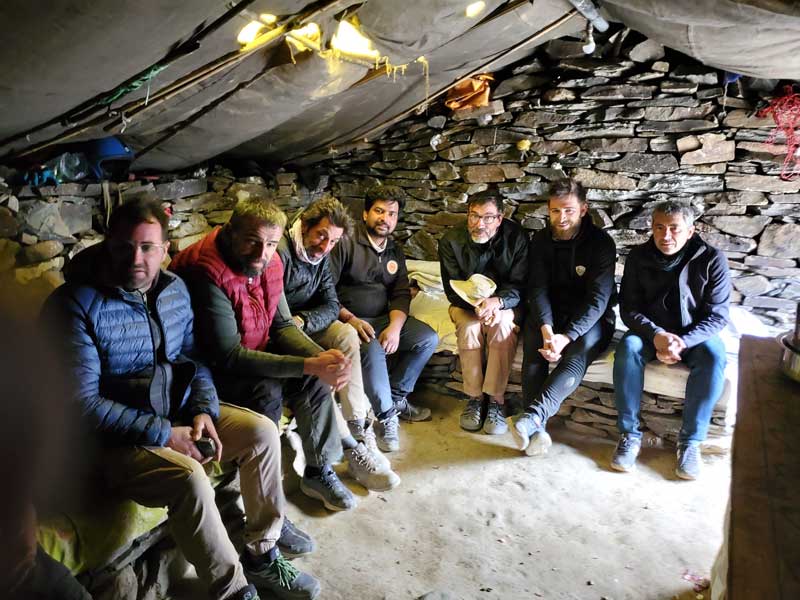 A warm kitchen on a cold night in Sarchu. | Photo Credit: Nash Ogden
Day 11: Our final riding day was almost entirely on good roads, but the environment changed again from dry desert to a land reminiscent of the Swiss Alps. We were on the way to Manali, but rather than crossing over Rohtang Pass, we took the newly completed Atal Tunnel. At 5.6 miles, it’s the longest single-tube tunnel highway above 10,000 feet in the world, saving almost 30 miles of dirt roads after a very long day. Upon its exit, we quickly dropped into the town of New Manali—an Indian mountain tourist mecca with parasailing, four-wheelers, zorbing, zip-lining, and a dinner-in-the-sky novelty restaurant. Thankfully, we continued on to Old Manali and our hotel, where we turned in the Himalayans and prepared to gather for a final dinner celebration. Dinner was at the Johnson’s Hotel Cafe and Bar, where we ate and drink like conquering warriors. The food, ambiance, and music were all first-rate, and by the time the evening was over, we were tentatively planning our next trip together. Maybe we’ll visit the eagle hunters in Mongolia….
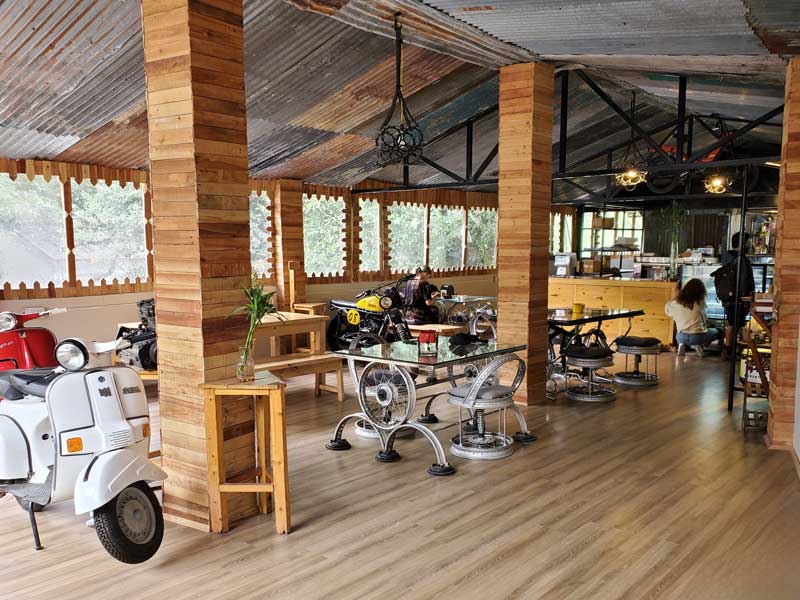 ME Garage Cafe in New Manali began as a way to pass the downtime of COVID and is now a thriving aditional business for the Buddhi Sing’s Motorcycle Expeditions touring company. | Photo Credit: James Carlisle
Trip Statistics:
- Total riding distance 945 miles
- 63,519 feet of elevation climbed
 James Carlisle is a retired military officer and a current fourth-grade teacher in Fairfax County, Virginia. He’s been an MSF Rider Coach for six plus years and has traveled the world on and off the motorcycle. He also works as a moto referee for USA Cycling and runs a small charity for underprivileged youth in South Carolina. When not in the classroom or riding, you can find him in his garage tinkering on cars and bikes.

 By
By