
But despite this being a big SUV, there isn’t much room in the back: Dakar rules require a massive 550-litre fuel tank, which takes up most of the boot and rear seat space. Three spare tyres are also crammed in, along with a tool kit including compressed air and integrated hydraulic jacks.
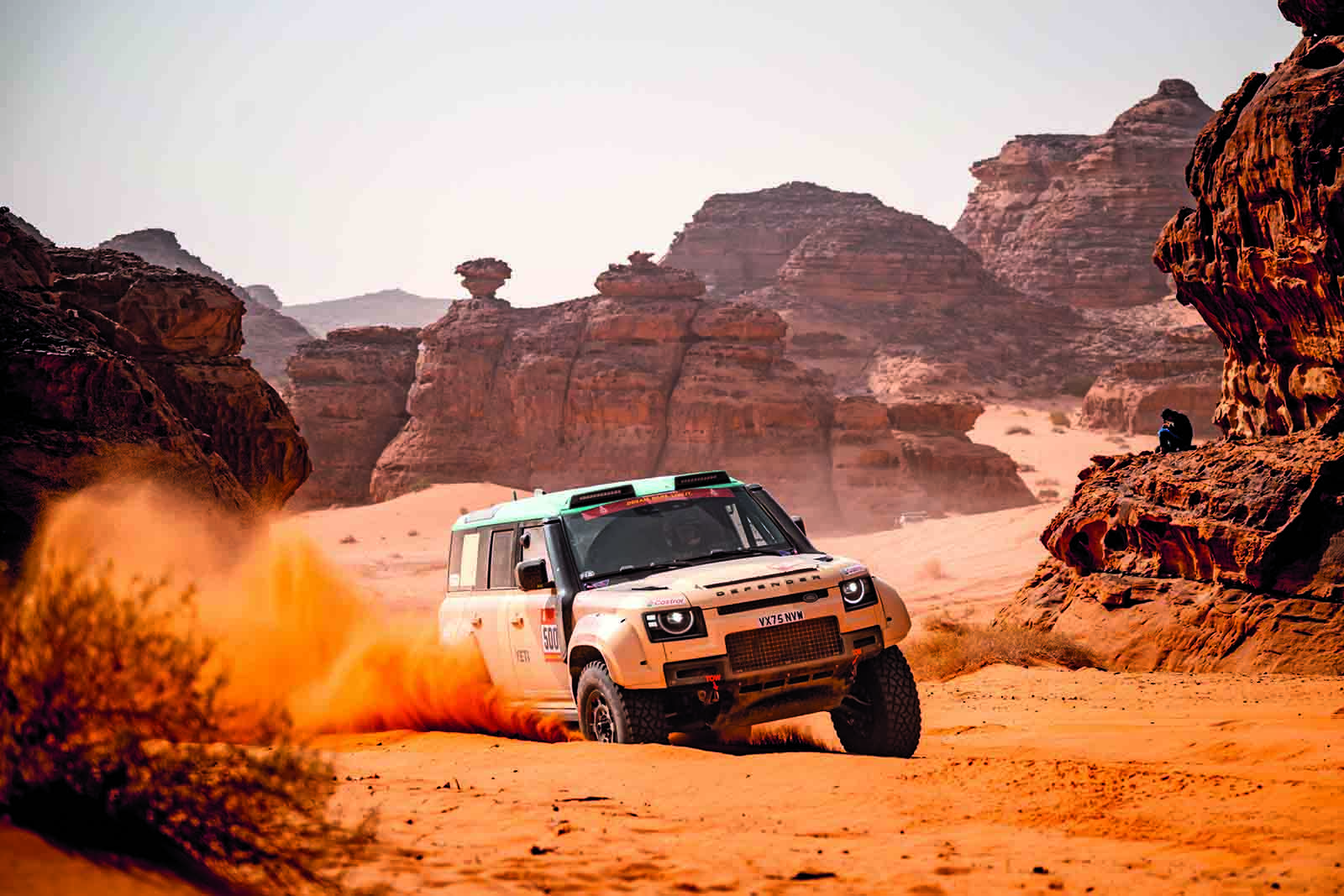
The D7X-R is a bit of a beast, basically. And much as it’s a road-legal stock car, it’s very much a full-on competition machine and the result of considerable work between JLR and Prodrive. It certainly looks the part in action: although it has around the same overall power as the vehicles in the Ultimate class, the Defender’s heavier production-based body and less aggressive suspension means it simply can’t match up on a rally stage.
And while it fared well in its Stock class, the opposition amounted to a quartet of privately run Toyotas and Nissans. That hasn’t put JLR off, though: it has made a three-year commitment, and Cameron is already eyeing staying an extra year, for the 50th anniversary of the Dakar in 2029. And the hope is that the Defenders will face a far harder time in the future, as more manufacturers are hopefully drawn to the Stock category.
“We want competition,” Cameron says. “If you’re only racing yourself, you’re always going to win. In motorsport you need competition. And from being here and the interest in the bivouac, I think in a few years there will be a healthy field of other manufacturers wanting to play with us.”
How did the Defenders fare?
Given their opposition amounted to a smattering of privately entered Toyotas and Nissans, the Defender squad was always likely to dominate the Dakar Rally’s new Stock class – and a clean sweep of stage wins is proof that it did just that.
If there was a surprise, it’s that it wasn’t Dakar legend Stéphane Peterhansel leading the way: a technical problem cost him nearly an hour on the first stage, before a snapped alternator belt on the eighth test ended any slim hopes, restricting him to fourth in class.
Instead, 26-year-old Rokas Baciuška dominated, taking a lead he would never lose on the first proper test and avoiding any major dramas on his way to the biggest win of his career by nearly four hours. Sara Price also took three stage wins on her way to second in class.
Crucially, despite suffering various mechanical issues, all three D7X-Rs made it back to Yanbu for the finish of the event.
 By
By