
I hate to break it to anybody already ruing the demise of throttle cables and hydraulic brake lines, but the steering column is the next bit of connective mechanical tissue up for the chop.
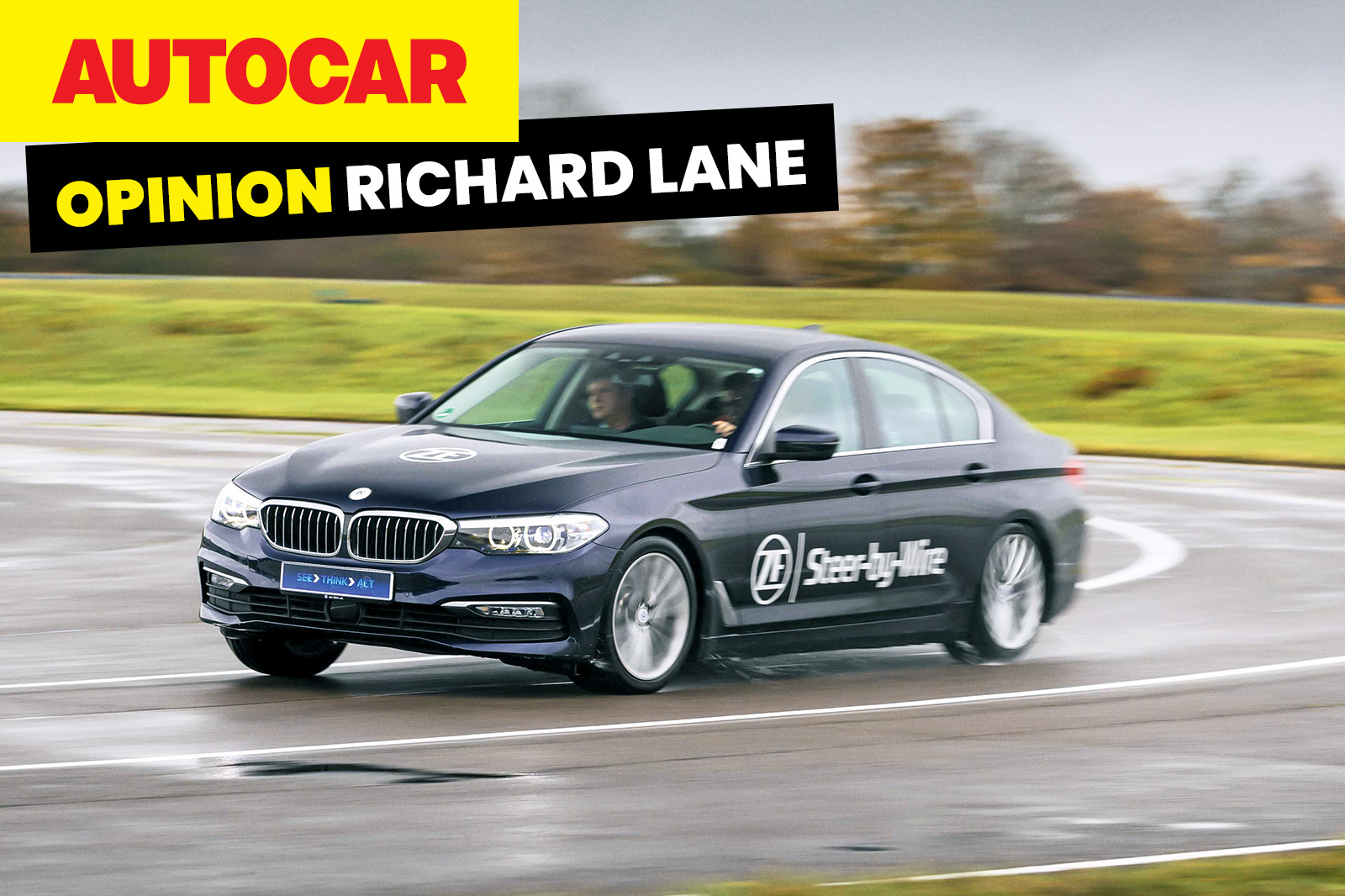
I interrupted our recent road test of the invigorating new Toyota Aygo X to join some ZF engineers at MIRA. They were in a modified G30 5 Series (with rare cloth seats – how delicious). Fitted to the car was a new steer-by-wire system already serving in Nio’s Chinese-market ET9 but due to appear in at least one senior Mercedes next year.
It captures the driver’s inputs with a steering wheel actuator, which then informs another mechatronic actuator on the front axle, turning the wheels the desired amount.
In reciprocation, torque sensors on the axle send a signal back to the steering wheel module. There that signal is translated into force by two worm drives that work independently around a single worm wheel, recreating load and, yes, even granular feedback.
It’s simple but, as ever, stupidly clever. It’s the second drive, which acts with or against its twin, that’s especially neat.
You may wonder why we need this technology. There are good reasons, according to ZF ride and handling specialist Duncan Church and his colleague Adam Heenan, an expert in active vehicle systems. Both engineers have worked in steering since the advent of electromechanical (EPAS) systems and insist that the by-wire approach isn’t a fresh start but something that builds on more than a decade of EPAS learnings.
They reckon that, because of the way in which these systems work, when it comes to what can loosely be defined as feel, there’s actually a smaller difference between EPAS and by-wire than exists between fully hydraulic and EPAS.
Crash safety is a big benefit. No intermediate shaft (as engineers call the column) waiting to be rammed back into the cabin in an accident is a good thing. With no physical connection between front axle and steering wheel, by-wire systems also remove the potential for thumb-snapping kickback. Equally, they can nullify undesirable kickback in normal driving.
Massively adaptive ratios are another reason why car makers are courting steer-by-wire. Cars are getting bigger and cities busier. Having a quick ratio at low speeds and a more languid one on open roads is clearly useful. It could change with a car’s drive modes too.
Delicate calibration of this stuff will be essential, of course, but this kind of versatility isn’t really possible with EPAS. Your SUV could serve up 180deg lock to lock. With by-wire you can also fold or even stow the steering wheel in the dash – useful for sleeping in a 4×4, or if your car is one day driving itself.
 By
By