

Robert Triggs / Android Authority
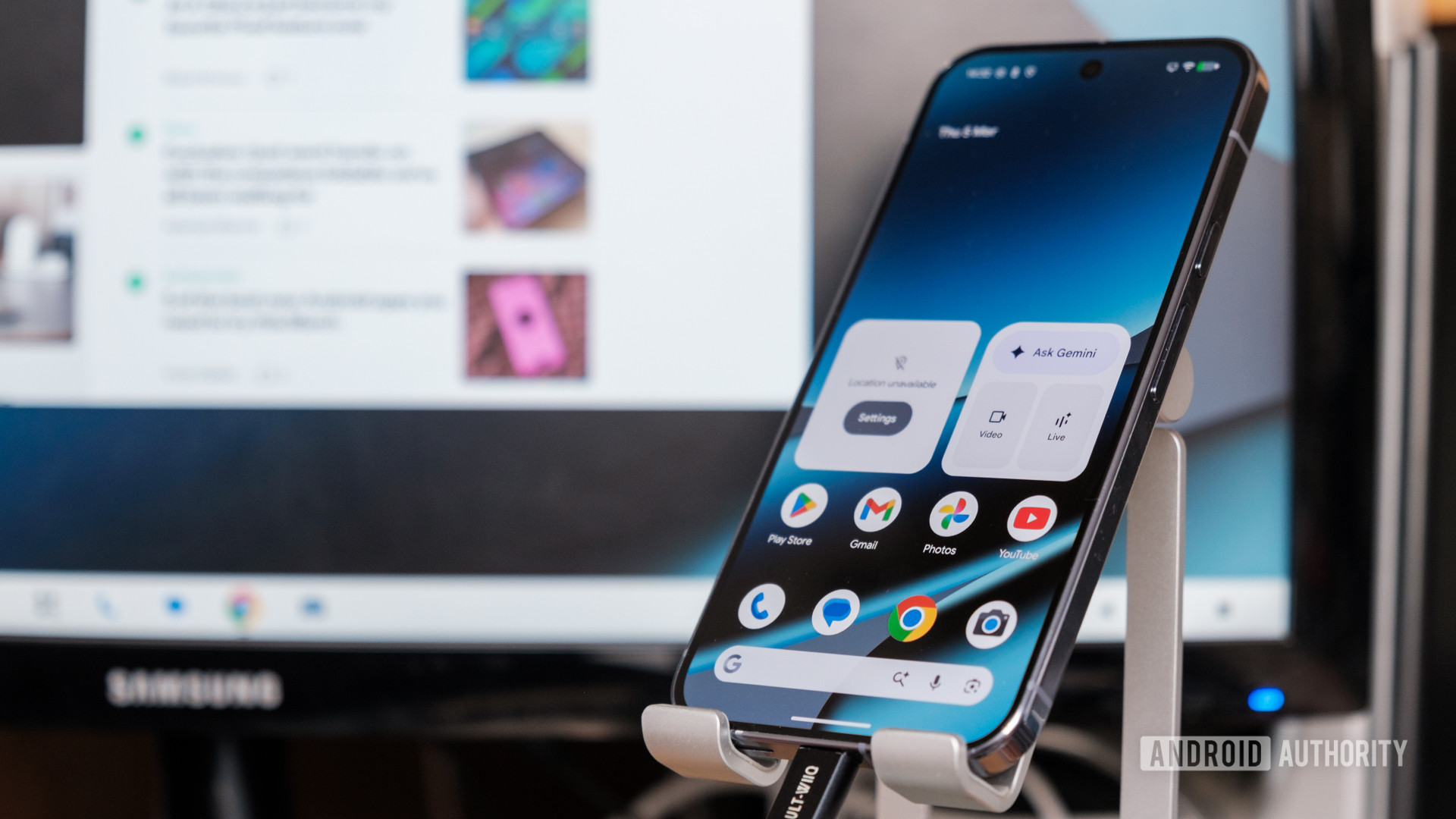
I’ve been using my Pixel’s new Android Desktop Mode since installing the March Pixel Drop, and I’m quite enjoying my time with it. It doesn’t take long to realize the potential here, especially given the ease of plug-and-play. After a few days of use under my belt, I now have a few observations and critiques.
On the one hand, being able to instantly switch to big-screen mode has proven really handy for powering through a quick email session and making edits to documents without having to reach for my laptop. But on the other hand, I’ve encountered a few annoyances of varying degrees that make me wonder if I really want to bother plugging my Pixel into a big screen again.
While there are occasional UI bugs, my one big complaint stems from Google’s key decision to share apps and settings across both phone and desktop — resulting in mild frustrations to outright inconveniences. This feature is at the core of what makes Desktop Mode so great, giving you instant access to the same apps, data, contacts, and more that you use on your phone. But sometimes you don’t want your PC to be a phone, too. You could say, Desktop Mode’s greatest strength doubles as its biggest weakness.
Will you use Pixel’s Desktop Mode?
2232 votes
Be together. Not the same

Robert Triggs / Android Authority
At the mildly inconvenient end of the spectrum, cosmetic settings are persistent across both modes. You can’t set a 16:9 wallpaper just for your desktop and automatically revert to a tall or animated wallpaper when you disconnect your phone. Instead, you have to try and find something that looks good on both, which is easier said than done outside of Google’s presets.
Likewise, icons, color themes, and dark mode settings would all be really nice to configure on a per-interface basis. Some things look better on a desktop, while others suit a phone environment, but you’re forced to use the same aesthetic settings for both. There is a small element of external display customization, but it’s limited to setting the screen resolution, rotation, and element sizes.
What is more irritating is that quite important settings are also fixed across both workspace domains. Screen timeout was my first serious aggravation. I’ve left my phone set to the standard 30-second screen-off timer, which is usually plenty of inactivity time when doomscrolling or replying to messages before I’d want my screen to autolock from potentially prying eyes.

Robert Triggs / Android Authority
But for my desktop, I can sit for longer than 30 seconds without moving the mouse or touching the keyboard if I’m reading or thinking. It’s beyond irritating to have to reach for the fingerprint scanner because the “computer” has decided to lock itself after such a short period of time. My laptop doesn’t turn off its screen until 5 minutes of inactivity, and doesn’t sleep until I’ve left it alone for 15 minutes straight. But extending the screen timeout would compromise my Pixel’s security when on the go.
For better and worse, settings are shared between phone and desktop mode.
One feature that would be harder to implement but no less welcome would be desktop versus phone Bluetooth auto-pairing. You need a mouse and keyboard to make the most of Desktop Mode, and pairing via Bluetooth is the easiest way to connect everything up. However, I don’t want my keyboard and mouse to automatically connect to my Pixel when I’m not in desktop mode; I probably want to use them with my laptop instead. Another issue arises when a mouse is left connected. Upon disconnecting my Pixel from the monitor, the homescreen can appear blank, likely because the device is ‘stuck’ in desktop mode.
Of course, there are some wireless devices that I’d like to keep connected in both modes, like my earbuds and maybe a game controller. This probably requires a more nuanced redesign than a simple toggle, but I think it’s something Android’s Desktop Mode needs to make it a more powerful tool that users would want to return to regularly.
Another behavior you might not anticipate is that Android makes some effort to remember your desktop space, but if you happen to clear used apps from your list of Recent apps when back in handheld mode (say to free up memory or just to reduce clutter), they’ll be gone from whatever desktop space you placed them in as well. This is obviously a side effect of both modes operating in the same user space; clear app memory from one, and it’s gone from the other as well.
This has the obvious benefit of seamless transitions between phone and desktop for tasks like editing documents or watching videos. However, it also clutters your phone with desktop workloads when you switch back. It would be nice if Desktop Mode automatically restored my previous desktop state when reconnecting, even if the apps were cleared from my phone. Reloading them is fine if needed. This would make it easier to resume work where I left off, which is how I feel many users will want to use Desktop Mode.
The potential is huge, but we’re not quite there yet

Robert Triggs / Android Authority
Android’s desktop implementation is really a very interesting setup. By sharing the same Android user space rather than booting into a dedicated PC space, you have instant access to the same apps, accounts, messages, files, and more that are already on your phone. This is Desktop Mode’s real power feature: you’re in the same OS environment with the option of two entirely different interfaces.
However, this comes with its own unique drawbacks. Mainly, there are some things you probably want to separate out for phone and desktop use. Customization, connectivity, and app shortcut requirements differ between the two modes. Some of the settings you’d expect are already in place, such as unique dock apps versus appdrawer shortcuts, but other important Android options aren’t.
Android Desktop Mode has immense potential, but until Google addresses these mode-specific settings and connectivity quirks, it remains more of a promising experiment than a fully polished desktop replacement.
Don’t want to miss the best from Android Authority?


Thank you for being part of our community. Read our Comment Policy before posting.
 By
By