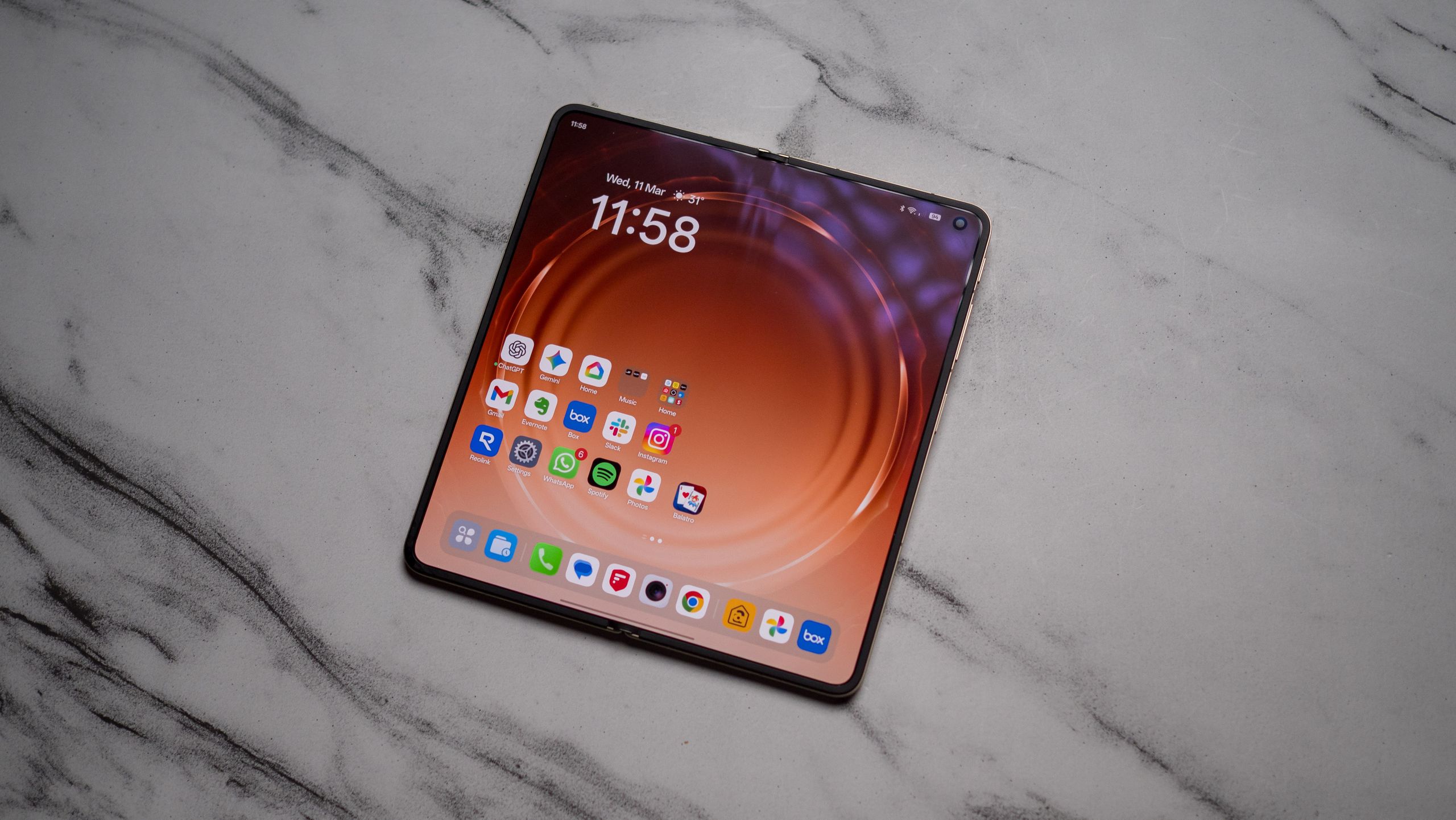

Chinese brands are pushing the boundaries of foldable tech, and OPPO is proving that point once again with the introduction of the Find N6. The foldable builds on the success of last year’s Find N5, with slight tweaks to the design to make it easier to hold and use, and new color variants.
The biggest upgrade this year is around the inner panel; the Find N6 has a creaseless panel without a visible crease, and it’s a monumental step in the evolution of foldables. OPPO calls this the Zero-Feel Crease, and it’s made possible by a combination of a new hinge architecture and a new flexible display.

Basically, the Find N6 has a new hinge mechanism that’s unlike any other foldable, and it results in the device having a fully-flat inner panel without any noticeable crease. I used the Find N6 for the better part of two days now, and the creaseless inner panel makes such a big difference that I don’t want to switch to another foldable.
Article continues below
You can still make out a crease along the middle when you see the foldable at an off-axis angle, but it is considerably less pronounced than what you get with the Z Fold 7, or even the Vivo X Fold 5. And in regular use, I didn’t see the crease at all.
Image 1 of 6


I like the design of the Find N6 quite a bit too; I got the orange color variant, and the pastel hue gives the foldable a much better presence than last year’s Find N5. The matte texture is great to hold, and it’s great to see that the LED flash module also has a tinge of orange. The mid-frame has a rose gold hue that accentuates the orange. and the rounded edges and flat sides with slight bevels make using the Find N6 a lot easier.
To get into a little bit of detail around the creaseless tech, OPPO is using a new titanium Flexion Hinge on the Find N6, and it uses a 3D printing process that’s designed to create an entirely level central plate. A key limitation with the hinge design is the microscopic height variances that result in the various components that make up the structure of the hinge, and by using liquid printing, OPPO says it was able to overcome these issues.

The new hinge has an increased folding radius that reduces the mechanical stress on the panel, and that should prevent any deformation of the inner panel even with extended use. OPPO is standing by the tech, stating that the Find N6 is guaranteed to fold 600,000 times.
This is because of the Auto-Smoothing Flex Glass that the brand is using instead of the traditional Ultra-Thin Glass (UTG) that you see on most foldables; this flex glass layer has better resistance to deformation, and it allows the inner panel to retain its structure much better.
Image 1 of 3


I generally like using foldables, but I’ve been hesitant to use one as a daily longer for longer than a month or two. Initially, it was down to the weight, but that isn’t a problem in 2026 — most recent foldables are just as easy to hold and use as traditional bar phones, and they’re unbelievably thin when unfolded.
Even the cameras have gotten much better over the last 15 months, and while foldables aren’t quite on the level of the Vivo X300 Pro or Find X9 Pro, they’re not a limiting factor. With the Find N6, OPPO is delivering a foldable that’s just as good as the Find X9 models, and the creaseless panel is a great starting point. I can’t talk about the rest of the foldable just yet, but I’ll share my full findings in my Find N6 review.
 By
By