
Published in: Rides

I wondered how long I could live on a can of tuna and a half-full Camelbak as I stared at my foot, flopping awkwardly to the side, no longer connected to the rest of my body by functional bones….

When did I last see a car? If someone comes by, will they help or rob me?
These were just some of the questions swirling in my head on the side of a dirt road in the remote Moskitia region of Northeastern Honduras, near the Nicaragua border. It wasn’t my first time riding alone through a distant corner of the globe, nor was it my first broken bone. It wasn’t even my first big crash. But it was my first time experiencing all those things at once.
Three months earlier I’d quit my job. Career-wise I was stuck in a rut, completely burnt out on what I was doing but unable to think of anything better. So six days after my last day in the office, I packed my bike and headed for the Mexico border.
Riding through Baja I found solitude. Wandering around the peninsula I stayed entirely on dirt, avoiding people, camping in arroyos, reading voraciously, and drinking myself silly. The mental quagmire I left behind—career, bills, expectations—seemed a thousand miles away. In fact, it was.
From the tip of Baja, I continued south toward Panama. Staying on backroads and avoiding the highways, I crossed from Mexico to Guatemala, and then from there into Honduras. Near the Honduras/Guatemala border I had a conversation which altered the direction of the trip, and also my life in an unexpected way.
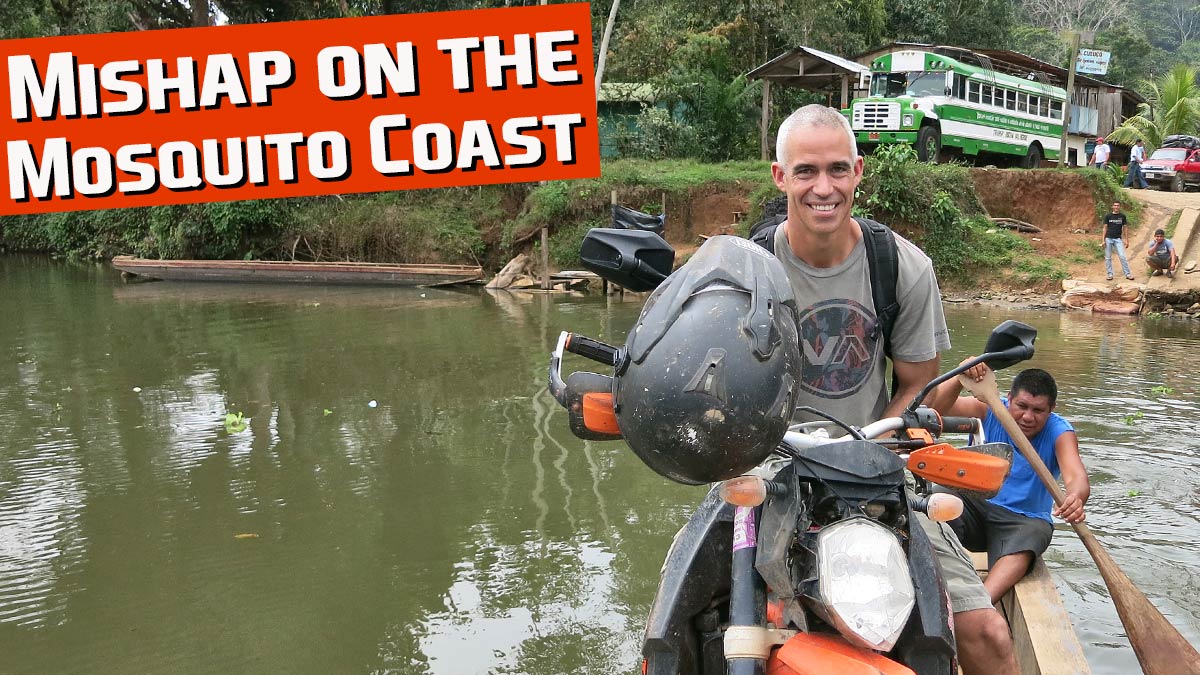
A bar owner told me about a remote and roadless corner of northeast Honduras called La Moskitia (aka the Mosquito Coast). He said that, despite its reputation for drug smuggling, it was a fascinating area and he thought it could be crossed by motorbike. I was on the hunt for interesting routes and I didn’t mind a detour, so I decided to give it a shot.

I rode north to La Ceiba and east from there, where the dirt roads braided and threaded, eventually merging onto a sandy double-track down the beach. It traced the shoreline, crossing river mouths, and occasionally leading up and over the coastal dunes into isolated Garifuna villages. It was clear from the stares and smiles that this part of Honduras doesn’t get a whole lot of visitors.
Eventually the beach dead-ended at a bay, where an assortment of small boats were pulled up on shore. There I met a gringo named Kevin who was loading supplies into a skiff. Kevin and his family live in a small Moskitia town called Belen. Once a month, he travels 400 miles by boat, truck, and bus for groceries and supplies. Kevin invited me to stay with him and I accepted, so we loaded the bike and headed downriver.
Our progress was slow because my heavy bike caused the skiff to sit low in the water and we frequently had to jump out and push the boat over muddy bottoms. Navigation became a challenge after dark. At one point we slammed into a submerged tree and nearly capsized. After that we slowed down even more and the trip—which would normally last only a few hours—went well into the night.
La Moskitia is littered with impromptu landing strips used by drug smugglers. I saw houses in the middle of nowhere with speedboats and armed guards on the dock. Wandering on a footpath through the ramshackle huts of Belen, a guy passed me on his shiny new quad with a bodyguard sitting on the back, AK-47 in hand.

One night at Kevin’s house, we took his guns and went down to the beach to investigate an unknown boat. The next night we woke up to blasts of automatic gunfire. Despite all that, when I was there it didn’t feel particularly dangerous, and I wouldn’t hesitate to travel through this area again.
Kevin helped me plan a route to Puerto Lempira by boat. The surprised captains were happy to carry my bike for the price of an extra passenger. The rides themselves were a blast, ripping along these tiny little rivers and seeing how people live along the shore. Abandoned drug-running boats were everywhere, stripped of electronics and motors. Every so often we’d pop out in a big open bay, cross it, and then duck back into the narrow little rivers. I made it to Puerto Lempira that night and I remember cracking a beer and thinking, “Damn that was fun!”
Leaving Puerto Lempira the next morning, it was an easy, fast ride through rolling grasslands with expansive views and graded gravel roads. Somewhere along the way I stopped at an army checkpoint and exchanged greetings with the soldiers.
I was headed for Nicaragua, but I crashed instead. There was no good excuse: I was going too fast, hit a ditch, and went over the handlebars. Lying on the ground and catching my breath, I took a quick physical inventory: my neck, shoulder, and left shin hurt, but not too bad.

The shoulder seemed to work, my neck was fine, and my ankle felt sprained. “Okay, great.” I thought, “I’m going to walk away.” Then I stood and excruciating pain shot up my leg. Falling to the ground, I looked down to see that my left ankle was dangling. I turned my knee to the right but the ankle didn’t follow, only pain.
After dragging around to collect my belongings and disconnect everything from the bike, I tried to get it upright. With only one leg I could get the bike only about foot off the ground, but no higher. I tried using my left leg a few times but the calf just buckled, which left me cursing, sweating, and rolling around in even more pain.
It was exhausting work, and the very real danger of using up my limited water. So I decided to wait and see if someone came along. I didn’t know if my leg was bleeding and I didn’t dare to remove the boot to find out. There was a good chance I’d be spending the night here, too.
A few hours later I heard the sound of an engine, and a large Honduran army truck full of soldiers came rumbling down the road. We were equally surprised to see each other. After some initial confusion, they offered me and the bike a ride back to their base. The base had no medical facilities and the generator was down, but they did have a landing strip. I camped there for a few nights trying to organize a flight. I couldn’t walk, but the soldiers splinted the leg with wood and paper, which helped reduce the pain.
After a few days I got a propeller plane to take me to Roatan, and a medevac flight from there to a hospital in Miami, where I had surgery to repair a broken tibia/fibula. After three more nights in the hospital I caught a flight back home to Washington State.

In the blink of an eye I was right back where I started, at home, hobbling around on crutches. You’d think I would be bummed. Instead, I was stoked and happy to be alive. It was a great trip and now I had an excuse to return, because my bike was still sitting at the base.
A few weeks later my buddy Andrew and I hatched a business plan to make our own line of off-road motorcycle luggage. Fresh from the recent trip, I was full of ideas, and Andrew (who had been designing bags for DaKine) had the skills and knowledge to develop those ideas into a saleable product. We spent the rest of the year planning, cutting, sewing, and testing our designs and named our new company “Mosko Moto,” a contraction of “Mosquito Coast.”
Last winter, 10 months after the accident, I returned to La Moskitia with our prototypes in hand, recovered the bike, and finished the ride to Panama. Man, was I ever happy to ride into Panama City.
Before this experience, I might have thought that being injured and alone on a dirt road in a remote corner of the world was among the worst things that could happen on an international moto trip. Instead, it led to an incredibly positive outcome. Now, over a year later, my leg has healed, the bike is home, and I finished the trip, and the big plus, I’ve started a new career doing something that I truly love. Maybe it’s a stretch to credit the broken leg with my new career direction, but it certainly played a role.
In the future I’ll worry less about the things that might go wrong and more about the real danger, which is not doing the trip at all. I want to do more, bigger trips, through wilder parts of the world. Sure I’ll do a few things differently—like take more water and ride slower—but in the end there’s only so much I can do. It’s risky but I’m going anyway. An inspiring thought for life, as well.
 MoskoMoto.com
Read more …
Source link
 By
By