
Why you can trust Android Central
Our expert reviewers spend hours testing and comparing products and services so you can choose the best for you. Find out more about how we test.
After 18 years of reviewing technology, it’s quite rare that smartphones can truly surprise or excite me, but last year marked a big moment. I love small phones and thin phones, which bucks the trend of bigger devices, and the iPhone Air and Galaxy S25 Edge both left me enamored when they were announced.
Yet neither became my main phone for one key reason: compromises. Both phones feature considerable compromises compared to their non-thin counterparts, especially as the latter become increasingly thinner with each generation.
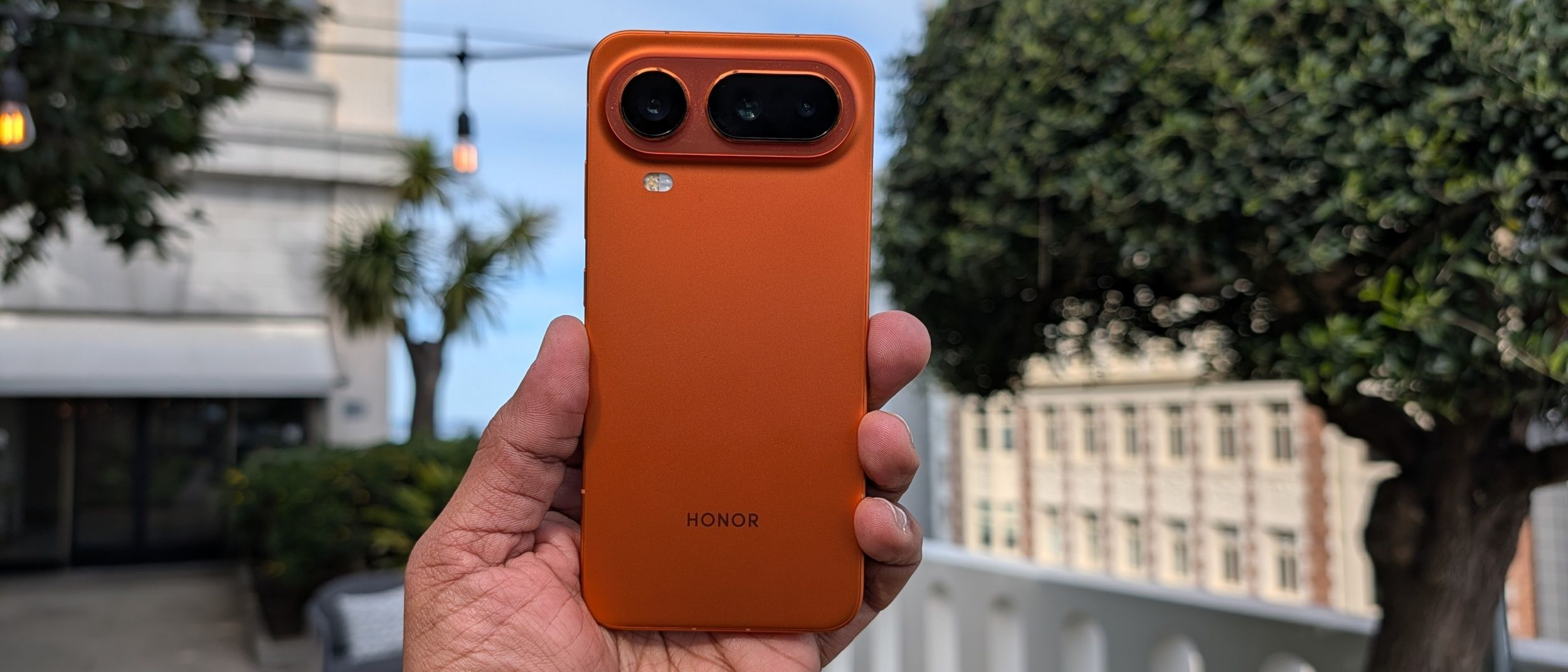
Meet the best thin phone ever made: the Honor Magic 8 Pro Air. It’s so good, it’s my favorite phone to use right now.

The Honor Magic 8 Pro Air is slightly thicker than the Galaxy S25 Edge and the iPhone Air, but this is a worthwhile trade-off. The Magic 8 Pro Air measures 6.1mm thin, compared to 5.6mm for the iPhone Air and 5.8mm for the Galaxy S25 Edge, but while it’s 0.6mm thicker, you’ll be grateful for it.
|
Specs |
Honor Magic 8 Pro Air |
|---|---|
|
Build |
150.5 x 71.9 x 6.1 mm |
|
Display |
6.31-inch LTPO OLED Dolby Vision, HDR 1800 nits HBM/6,000 nits peak brightness |
|
Chipset |
MediaTek Dimensity 9500 SoC |
|
Memory/Storage |
12GB RAM/256GB 12GB RAM/512GB 16GB RAM/512GB 16GB RAM/1TB |
|
Main Camera |
50MP, f/1.6, 23mm, 1.2µm, multi-directional PDAF, OIS |
|
Ultrawide Camera |
50MP, f/2.2, 16mm, 112° field-of-view |
|
Telephoto Camera |
64MP periscope telephoto, f/2.6, 74mm, 3.2x optical zoom, OIS |
|
Selfie Camera |
50MP, f/2.1, 21mm |
|
Battery |
5,500 mAh Silicon Carbon |
|
Charging |
80W wired charging 55W wireless charging |
|
Connectivity |
Wi-Fi 7, Bluetooth 6.0, NFC, GPS, USB-C 2.0 OTG |
|
Colors |
Black, White, Purple, Orange |
|
Price |
¥4,999 (~$717) |
The reason? Much better cameras, a much larger battery, and considerably faster charging. The result is the only thin phone that feels like it doesn’t really compromise the flagship phone experience, especially compared to the competition.
It’s also worth noting that Honor managed to do all of this in a body that’s smaller than the competition as well, which makes the Magic 8 Pro Air even more enjoyable to use.

The Magic 8 Pro Air features a vibrant 6.31-inch display, complete with Dolby Vision and 6,000 nits peak brightness, and it resonates with me because I love small phones; this is much more comfortable to use in one hand than the 6.5-inch display on the iPhone Air (which is near perfectly sized) and the 6.7-inch display in the Galaxy S25 Edge, which I find a little too large.
If Honor had picked a larger display, it might not have been as enjoyable for me, but there’s a strong chance they could have made it thinner as well. Regardless, this is among the best-designed phones I’ve used in years, and as we’ll see, it finally addresses the key compromises of other thin phones. It also comes in four colors — Black, White, Purple, and Orange — and yes, I’m using the now-very-familiar Orange variant that looks just as stylish as my iPhone 17 Pro.

Battery and charging are key areas in which the Magic 8 Pro Air excels compared to the competition, and simultaneously solves the biggest issue with other thin phones.
The iPhone Air features a 3,149 mAh battery, with Apple also making a separate iPhone Air MagSafe battery pack that close to doubles the capacity. At around 7mm thick, this more than doubles the iPhone Air’s overall thickness to ~13mm when used together. Meanwhile, the Galaxy S25 Edge features a larger 3,900 mAh battery with no official Qi2 battery pack.

In comparison, the Magic 8 Pro Air excels considerably, featuring a 5,500 mAh battery with support for 80W wired charging and 50W wireless charging. For context, this is larger than the battery in the iPhone 17 Pro Max, the new Galaxy S26 Ultra, or even folding phones like the Galaxy Z Fold 7. It takes around 50 minutes to charge the Magic 8 Pro Air to full, which is also faster than both the iPhone Air and the Galaxy S25 Edge.
I was shocked by the battery size, and then even more shocked when it delivered the exact all-day battery life I’ve been waiting for from a thin phone. Over the past few weeks, the battery life has averaged around 5-6 hours of screen time per day, which is more than enough, but I’ve also had it go over seven hours when used mostly on Wi-Fi. This is incredible, and simply put, the Magic 8 Pro Air is the first thin phone to offer true flagship battery life.

The camera is another area in which the Magic 8 Pro Air excels. The iPhone Air features a single 48MP camera, while the Galaxy S25 Edge features a 200MP main camera and a 12MP ultrawide camera. Yet both lack the full range of camera features you’d find in either company’s flagship phones, which is another reason some customers may have opted against the thin variants.
The Honor Magic 8 Pro Air doesn’t have such compromises.
Image 1 of 20


The Magic 8 Pro Air shows that thin phones can have great cameras, thanks to a 50MP main camera with f/1.6 aperture, a 50MP ultrawide camera, and a 64MP periscope telephoto camera with 3.2x optical zoom.
Image 1 of 5


This is virtually identical to the camera system found in the new Honor Magic V6 folding phone, but the Magic 8 Pro Air also has a much better 50MP selfie camera.
Image 1 of 7


I’ve been waiting for a thin phone that actually delivers in the camera department, and this is the first phone not to disappoint: the Honor Magic 8 Pro Air is the first thin phone to actually deliver a flagship camera experience, and it’s absolutely wonderful to use in real-world usage.

Thin phones often struggle with cooling under heavy performance, but the MediaTek Dimensity 9500 processor inside the Magic 8 Pro Air stays noticeably cooler than any other thin phone, even when using on-device AI features.
Similarly, Honor’s software is well-optimized for both the form factor and the lack of thermal window, and the phone has yet to struggle, crash, or lag in any way. Yes, it runs a Chinese ROM, so you can’t set a different default launcher, but aside from that small point, Honor’s Magic UI is fantastic and intuitive to use.

There’s also full support for Google Apps, support for eSIMs — which is extremely rare on Chinese phones — and even a SIM tray, which is missing from the iPhone Air. This could easily launch globally with very few tweaks to the UX.
The under-display fingerprint sensor works well, but I do wish Honor had adopted a fingerprint sensor on the power button instead. And just to prove it’s truly a flagship, there’s also IP68 and IP69 dust and water resistance, with the latter proving to be a key differentiator that many non-thin phones don’t even offer.

The Magic 8 Pro Air is the best thin phone ever made.
This is a big statement, and the caveat is that there aren’t that many. Having tried every thin phone — including the Tecno, Huawei, and Motorola versions that are limited to China or elsewhere — one thing is clear: the Magic 8 Pro Air is the best thin phone ever made.
I’ll take it a step further: it’s one of the best phones ever made, thin or otherwise. Honor has proven that thin phones can be made without many compromises, and in doing so, it’s set a benchmark for other companies to follow. If a thin phone can be this good, what does it mean for non-thin phones going forward? Regardless, it’s already one of my favorite Android phones, and aside from the best folding phones, it’s setting a benchmark that I’m not sure the competition will beat.
The only downside to the Magic 8 Pro Air? It’s exclusive to China only, at least right now. It starts at ¥4,999 (~$717) for the 12/256GB version in China, with the top variant costing ¥5,999 for 16GB of RAM and 1TB of storage. It would be more expensive in global markets, but there’s no doubt in my mind that Honor needs to bring this to global markets. It’s that good that every country deserves to be able to buy this.
 By
By