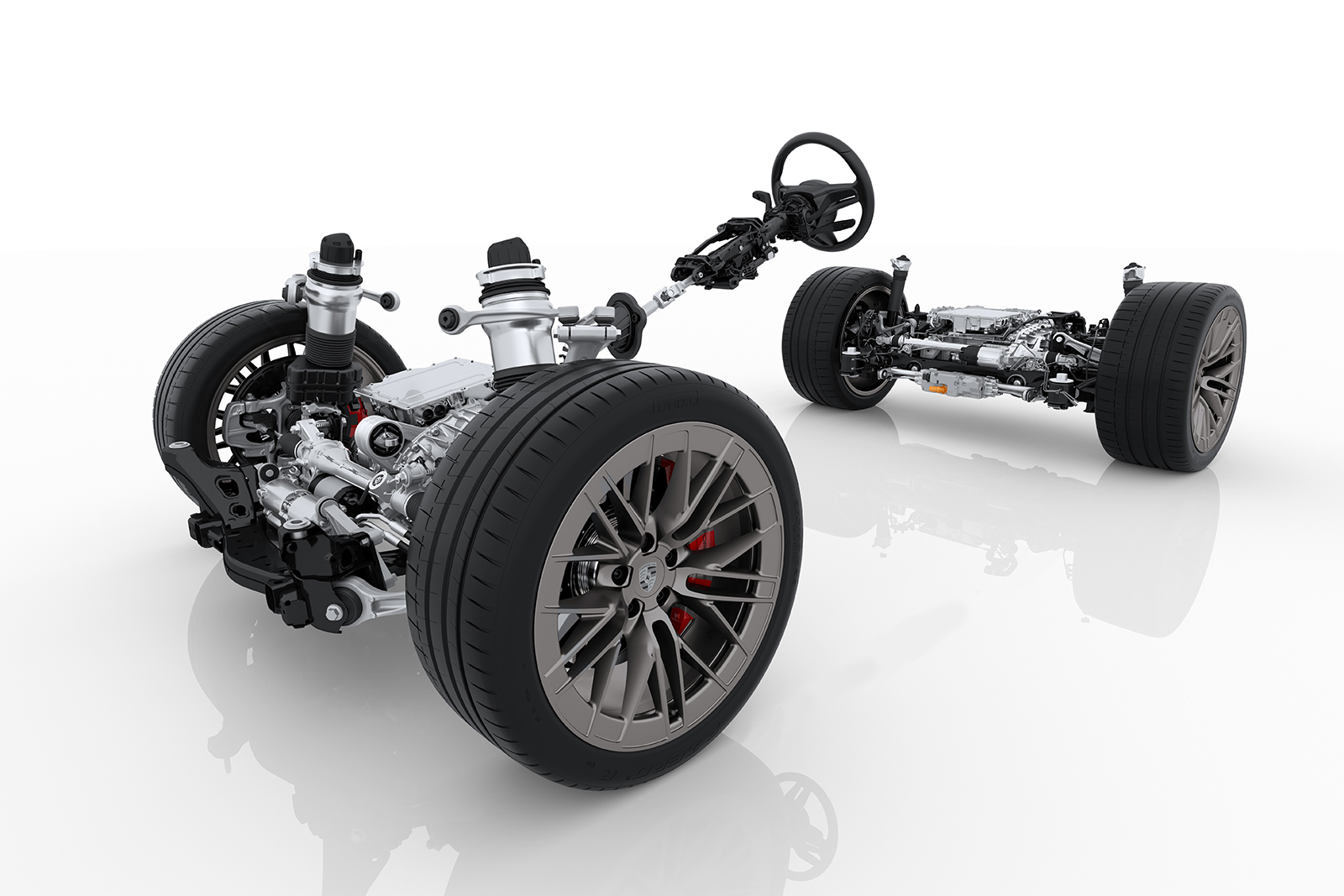

The Porsche Cayenne Electric went into production earlier this year, with its headline output of 1140bhp making it the most powerful production Porsche yet.
Despite that, the hefty SUV has a respectable 373-mile range. So how has Porsche achieved that?
The modules of the 113kWh battery were developed in-house and are made in the Porsche Smart Battery Shop at Horná Streda, Slovakia. The facility was set up in conjunction with Porsche Werkzeugbau GmbH, a Porsche tool-making subsidiary that plays a key role in moving projects from the prototype stage to series production.
The battery supports 800V ultra-rapid charging at up to 400kW, taking it from 10-80% capacity in under 16 minutes. It can maintain a high charge rate of between 350kW and 400kW at up to a 50% state of charge from 15deg C, too, improving on previous cold weather charging performance.
It can also charge at 400W stations at up to 200kW. The lithium-ion battery pack is composed of 192 large-format pouch cells with graphite-silicon anodes and nickel-manganese-cobalt-aluminium (NMCA) cathodes. The cells’ high nickel content of 86% gives an energy density that betters that of the Taycan battery by 7%, and the use of silicon in the anodes contributes to the battery’s ultra-fast charging.
Thermal management is key to battery performance, so this one has a double-sided cooling system to regulate the pack’s temperature from both above and below in a kind of ‘coolant sandwich’.
The internal temperature should in theory remain in the optimal range regardless of ambient conditions, charge power or driving style thanks to a cooling capacity equivalent to that of 100 large household fridges.
Energy-efficient fans pump cooling air and consume 15% less energy than conventional suction fans. A predictive thermal management system links all vehicle cooling and heating circuits, continuously analysing temperature, route, driving profile and heating and cooling needs in real time.
The battery is integrated into the structure of the Cayenne and is classed as a structural component, to save weight and space. As a result, the ratio between the cells and the overall battery housing has improved by 12% compared with the second-gen Taycan battery – the battery weighs less and takes up less space for the same power and capacity.
Integration with the structure also increases rigidity and lowers the centre of gravity – two things car makers are always striving for. It’s safe, too: Porsche says the modules are made from a special aluminium profile that absorbs energy and protects the cells during an impact.
 By
By