
As powerful and feature-laden as modern-day smartphones are, the one thing that I absolutely despise about them is their physical footprint. Granted, design “improvements” like taller displays and thinner bezels have allowed manufacturers to make devices with absolutely incredible screen-to-body ratios, but the fact remains that the majority of the best Android phones are downright impossible to use with one hand, even more so due to the continued increase in their overall heft.
Having crisp AMOLED panels and selfie cameras with 4K video recording doesn’t mean much if you have to resort to hand gymnastics every time you want to use your shiny new smartphone.
Article continues below
What exactly is Quick Cursor, and how does it work?

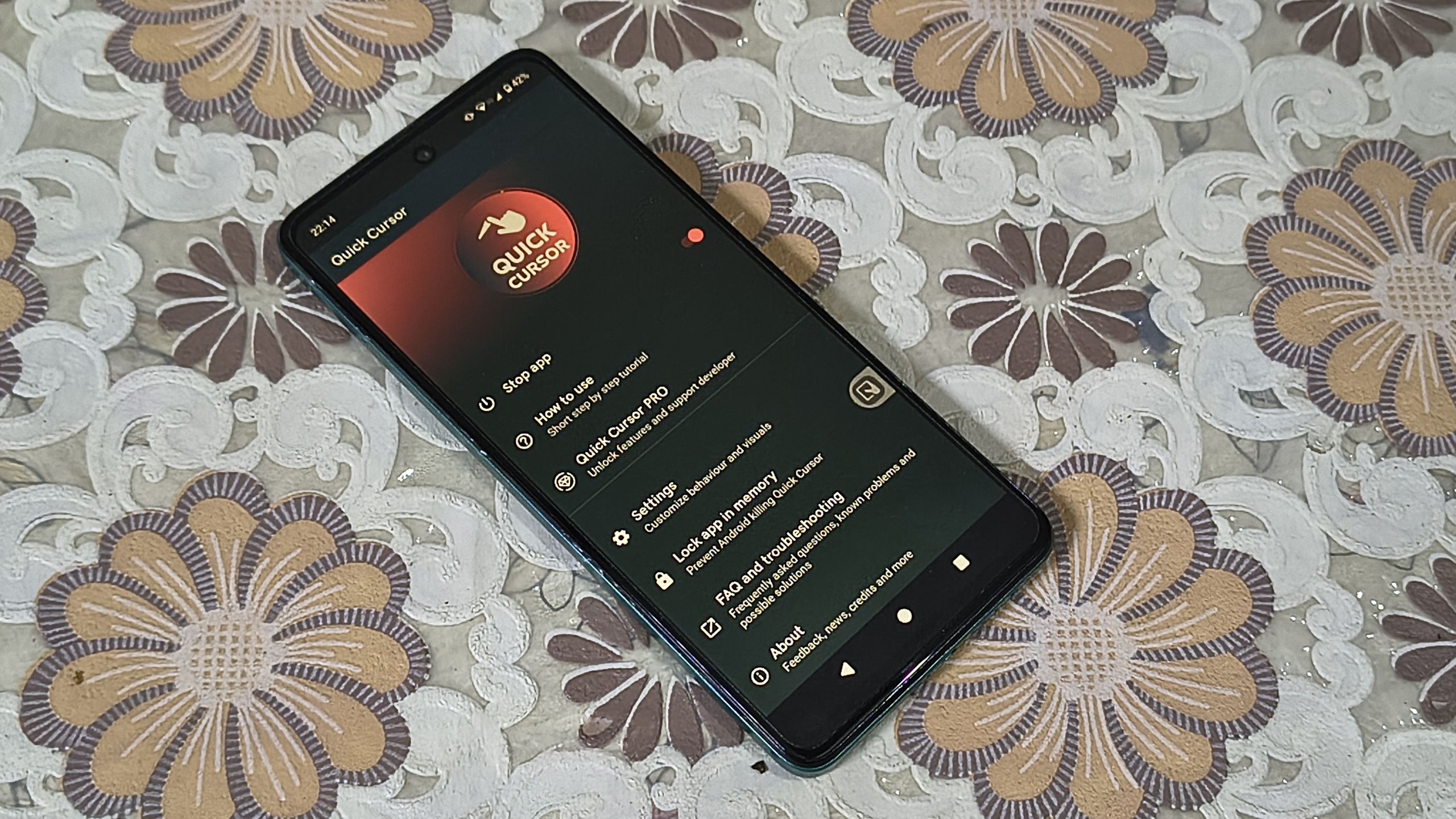
Quick Cursor is available on the Google Play Store and does exactly what it says on the tin. The app is designed to make one-handed use easier and works by overlaying a floating cursor on the phone’s display. You can invoke the cursor by swiping inwards from the lower half of the screen, and then use it to interact with UI elements on the upper half of the display. This allows you to easily reach UI elements without stretching your thumb all the way to the top of the screen.
The cursor is moved around using a tracker, which turns the smartphone’s touchscreen into a virtual trackpad. The tracker supports both tap and swipe actions, which simulate the actual touch gestures that we use on our smartphones.
How to set up and configure Quick Cursor
Getting started with Quick Cursor is fairly simple. Once you install it, you’ll be presented with a quick setup to allow it access to Android’s accessibility service. Just follow the steps to complete the initial configuration.

Once the setup is done, you’re ready to go. Simply swipe inwards from the left or right edge of the bottom half of the phone’s screen, and you’ll see a floating circular cursor and a tracker on the display. Swipe the tracker to position the cursor on the UI element that you want to interact with, and tap the tracker to execute the tap or swipe action.
Note: Moving the cursor to the top edge of the display automatically pulls down the quick settings/notification panel by default.
You can open the app anytime to adjust its settings. Quick Cursor uses the freemium model, which means that the basic functionality of the app is free, and there are no ads. However, if you want more features, you can either pay for an annual subscription or opt for a one-time purchase.
Doing so unlocks a multitude of options, such as custom double-tap/long-tap/second-tap (while holding the tracker) actions, the ability to back up and restore settings, and more. You can also blacklist/whitelist apps so that Quick Cursor only works with the apps of your choice.

Why do I like Quick Cursor more than Android’s one-handed mode?
You might be familiar with the ‘One-handed mode’ feature that Android has had for quite a while now. It works by pulling down the UI elements on the top half of the display, thus making them easier to access. Sure, it works as intended, and you don’t have to install an extra app, but I find it clunky. Moreover, if you’re doing something that requires you to repeatedly interact with UI elements on the upper half of the screen, the switching between a half-screen and a full-screen display can be quite jarring.
Conversely, I believe Quick Cursor does a better job of accessing difficult-to-reach UI elements. It’s among the very few apps that let you interact with the top half of your smartphone’s display without stretching your thumb or adjusting your grip. It does take some time getting used to, but once you get the hang of it, things get quite easier.
Using your smartphone doesn’t have to be a chore
Even though devices like the Samsung Galaxy S26 Ultra or the Google Pixel 10 Pro XL are some of the best examples of the numerous advancements in mobile technology, they’re far too unwieldy to use comfortably. And with the rising popularity of foldable phones, screen sizes are only going to get bigger.
This is where apps like Quick Cursor can help. Sure, it’s not a replacement (and will never be) for a sensibly sized smartphone, but I think it does make using the colossal phablets that we have today a bit easier. You can consider giving it a try and see how it works out for you.
 By
By