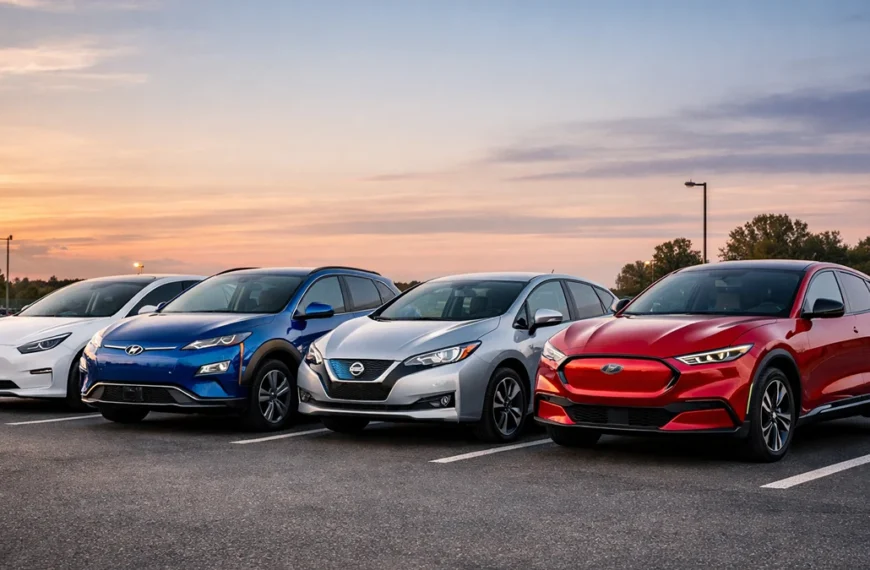
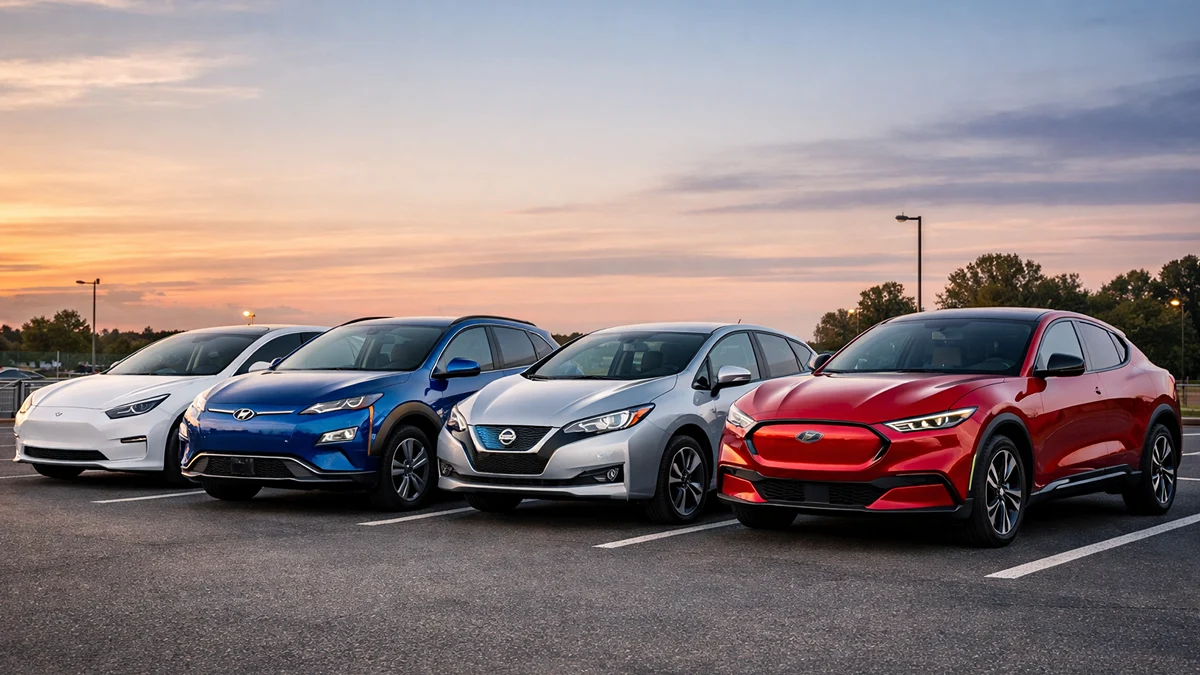

Something unusual is happening in the used car market: late-model EVs are sitting on lots and at auction for prices that would have seemed impossible two years ago. A Hyundai Kona Electric, a Ford Mustang Mach-E — vehicles that sold near sticker price in 2022 are now routinely going for a third less. In some cases, even more.
Scott Case, CEO of Recurrent, one of the most closely followed EV market research firms in the industry, called 2026 “the year of the used EV.” The data backs him up. The question is: Is now a good time to buy an electric vehicle?
Why Are Used EV Prices Dropping in 2026?
Let’s take a closer look at the factors pushing the EV car’s price drop:
The lease return flood. Between 2023 and 2025, automakers leaned hard on leasing to move electric vehicles. More than 1.1 million EVs were leased during that stretch, largely because the so-called IRA leasing loophole made it easier to claim a $7,500 tax credit when leasing than when buying outright. Those lease terms are ending now, creating an oversupply of used electric cars hitting dealer lots and auction platforms in 2026. EV lease returns are projected to surge roughly 230% compared with 2025.
Federal tax credits expired. The $7,500 new EV purchase credit and the $4,000 used EV credit both expired at the end of September 2025. Without the incentive, new EV inventory ballooned to 130 days’ supply, which is 46% higher than the 89 days’ supply for combustion vehicles. Dealers with unsold new EVs are cutting prices, and those cuts ripple directly into used values.
Technology is moving fast. New 2026 models offer 50–100 more miles of range, faster charging, and better build quality compared to EVs from 2021–2023. That progress makes a 3-year-old EV feel less current than a 3-year-old gas car would, which pushes used prices down faster than buyers are used to seeing.
New car price cuts created a domino effect. When a new model drops $8,000 in price, every used version on the market has to follow immediately. Tesla started this cycle in 2022, and most major brands followed. For original owners, the depreciation hit was brutal. For buyers today, it’s an opportunity.
How Much Have Used EV Prices Dropped?
The numbers are genuinely striking. By early 2025, the average 1–5-year-old used EV had fallen roughly 15% year-over-year, landing around $32,000, compared to just a 0.5% decline for gas and hybrid models over the same period. In total, average used EV prices are now down 30–40% versus their 2022–2023 peaks.
Luxury EVs have come down the furthest. Models like the Tesla Model S, Audi Q8 e-tron, and Mercedes EQS have lost 60–72% of their original value within five years. A vehicle that sold for $80,000 new is now sitting in inventory at $21,000–$45,000.
Here’s a model-by-model look at where prices stand, based on iSeeCars research comparing listing prices between September 2025 and January 2026:
| Model (1–5 yr old) | Price Change (Sep — Jan) | Approx. Current Range | EV Price Trends 2026 |
| Tesla Model 3 | +2.6% | $23,000 — $31,000 | ↑ Rising |
| Tesla Model Y | +1.3% | $26,000 — $35,000 | ↑ Rising |
| Tesla Model X | +10.3% | $50,000 — $65,000 | ↑ Rising |
| Hyundai Kona Electric | −6.4% | $18,000 — $24,000 | ↓ Falling |
| Volkswagen ID.4 | −6.2% | $20,000 — $27,000 | ↓ Falling |
| Ford Mustang Mach-E | −5.1% | $22,000 — $31,000 | ↓ Falling |
| Nissan Leaf | −4.6% | $11,000 — $18,000 | ↓ Falling |
| Chevrolet Bolt EV | Slight decline | $13,000 — $20,000 | ↓ Softening |
Notice the clear split. Average used Tesla prices rose 4.3% to $31,329 after credits expired, while the average price for the rest of the used EV market fell 3.6% to $23,738. Tesla is moving against the trend largely because discontinued Model S and X variants have tightened supply. The other reason is that Tesla buyers tend not to depend on incentives the way mainstream buyers do.
Is It a Good Time to Buy a Used EV in 2026?
For most buyers, the answer is yes, but with a few things worth keeping in mind. The pricing window is real. Whether it stays open is a more interesting question.
The steepest declines already happened in 2023–2024. Prices are stabilizing near a new normal rather than continuing to free-fall. And as of early 2026, 44% of used EV transactions are landing below $25,000, with 56% of all used EV inventory priced under $30,000. Many of those are 2023 model year or newer.
EV vs. Gas: The reality of ownership costs. Studies consistently show EVs cost 40–60% less per mile to fuel than gas vehicles. Add in fewer brake jobs (thanks to regenerative braking), no oil changes, and simpler drivetrains overall. The long-term ownership math tends to favor an EV even if you pay a similar upfront price.
Pros of buying a used EV right now
- Near-floor prices. Non-Tesla EVs are at or close to their lowest point since the early 2020s market boom.
- Premium features for less. Long-range crossovers, advanced driver assistance, and premium interiors at mid-market prices.
- Lower maintenance costs. Electricity is cheaper than gas, and maintenance is simpler across the board.
- Battery warranties are still active. Many 2021–2023 EVs are still under the manufacturer’s 8-year/100,000-mile battery warranty.
Cons to consider
- Battery degradation. Battery health is the single biggest driver of long-term EV value. A pack that has lost 20–25% of its capacity will affect its range and resale value. Always check the state of health before committing.
- Insurance tends to run higher. EVs generally cost more to insure than equivalent gas cars, mainly due to battery replacement costs and specialized repair labor.
- Charging compatibility. Older CCS-only EVs without NACS adapter support may face some inconvenience as the US charging network continues its shift toward Tesla’s connector standard.
- Resale value is less predictable. While prices have stabilized, rapid technology improvements make long-term resale harder to forecast than with a gas vehicle.
Where to Find Cheap Used EVs in 2026
Dealerships are one option, but they’re rarely the most cost-effective one. Most dealers have already priced in the current market and added their margin on top. Auto auctions, especially online salvage platforms, are where serious buyers tend to find the real deals.
Auction platforms like Copart list insurance write-offs, fleet disposals, and off-lease returns that never reach a traditional lot. On AutoBidMaster, an official Copart broker, you can browse wrecked EV cars for sale across thousands of active listings, from minor-damage Kia EV6s to flood-affected Model 3s, and bid directly without a dealer license.
Salvage EVs are particularly interesting right now. A vehicle with hail damage or a rear-end collision can retain a fully functional drivetrain and battery pack. After repairs and a state inspection, you can end up with a capable electric car at a fraction of what you’d pay on a dealer lot.
Tips for Buying a Used EV at Auction
Preparation pays off when buying at auction. The more you know going in, the better your position when it’s time to bid. A few things to check before placing any offer:
Battery health should come first. High state of health packs command a premium, and cars still under an 8-year/100,000-mile battery warranty are generally the safer bets. For salvage EVs, review the damage report carefully. Collision and hail damage rarely affect the battery pack directly, while flood damage is a different story and requires much closer scrutiny. If you’re considering a salvage rebuild, this step-by-step guide to REV battery repair is worth reading before you commit.
Match the charger to your routine. Check whether the vehicle uses CCS, NACS (Tesla’s connector, now adopted by most automakers), or the older CHAdeMO standard. This affects day-to-day convenience and resale value.
Know what the damage type means. Front-end collision, hail, and mechanical total losses are typically more straightforward to repair. Fire and flood events carry more risk and hidden complexity. Auction listings include damage codes — read them before you bid, not after.
Add up all the costs. Buyer’s premium, transport, repairs, title fees, and state inspection costs all add to the purchase price. Run the full numbers before bidding, not after winning.
Quick tip: Looking for a specific model? Search by make and damage type to narrow things down fast. You can explore salvage Teslas for sale or go straight to salvage Ford Mach-Es to see what’s currently available at auction.
Electric Car Future Predictions

Falling EV prices in the USA aren’t a sign of a troubled market. They’re the natural correction after a period of unusually inflated values. And for buyers, that correction is the opportunity. The pricing window is wide open right now: more inventory, more models to choose from, and prices near their floor for most non-Tesla EVs.
The window won’t stay open indefinitely. As lease returns peak and inventory starts to tighten. In late 2026 into 2027, used EV prices will stabilize further and eventually firm up. The buyers who act in this window are the ones who will look back on it as a genuinely smart move.
Auto auctions give you the most direct access to that inventory, at prices set by the market, not a dealer’s margin. If you haven’t started exploring yet, now is a good time to start.
Register a free AutoBidMaster account and start bidding within minutes. Thousands of electric vehicles — Teslas, Mach‑Es, Kia EV6s, Bolts, and more — are available at auction now.
FAQ
Are EV car prices dropping in 2026?
For most non-Tesla models, yes, but the pace is slowing. Prices are down 30–40% from 2022 peaks and are still softening in early 2026. Analysts expect prices to stabilize rather than drop sharply again as lease returns peak and supply normalizes.
Why have EV prices dropped for most models, but not Tesla?
Two main factors: the discontinued Model S and X variants have tightened supply, and Tesla buyers tend to be less sensitive to incentive expirations than mainstream EV buyers. When the federal tax credits ended in September 2025, non-Tesla brands cut prices to offset the loss. Tesla didn’t need to.
Should I buy an EV now or wait?
If you’ve found a model you like at a price that works, now is one of the strongest buying windows in recent years. Prices are near their floor for most models, and the best inventory, especially at auction, moves quickly. Waiting until late 2026 risks missing peak supply before the market firms up again.
How long do EV batteries last in a used car?
Most modern EV batteries are covered by an 8-year/100,000-mile warranty that guarantees at least 70% capacity. In practice, well-maintained packs from major brands have shown relatively low degradation. Many retain 85–90% capacity after 100,000 miles. Battery replacement costs have also dropped 20% recently, and industry forecasts expect them to reach price parity with major gas engine repairs by 2030.
Is it worth buying a salvage EV at auction?
It can be a smart move, especially for collision- or hail-damaged vehicles whose drivetrain and battery are unaffected. You access auction-level pricing, repair the cosmetic or structural damage, and end up with a capable EV well below market value. Flood and fire damage pose significantly greater risks and require closer scrutiny. Always review the damage report and run a VIN check before bidding.
Sources (accessed March 2026):
- Cox Automotive Q1 2026 Insights
- iSeeCars EV Market Study
- Recurrent Auto Q1 2026 Report
- Electrek
 By
By