
Tyre wear has always been a challenge for the people who manufacture them.
Too much of it is undesirable from a value-for-money point of view, but also because as tyres wear so does the road surface, producing tiny particulates that pose an emissions problem.
Friction between a tyre’s contact patch and the road is an obvious cause of wear but, says Continental, many factors contribute to the generation of tyre and road wear particles.
According to Continental and the European Tyre and Rim Technical Organisation, these factors include (in order of rising influence on wear), weather, temperature, tyre design, vehicle, road surface, route topology and, most of all, driving behaviour.
It’s a subject that major tyre makers such as Continental and Michelin have been studying closely for years and pressure has grown to find improvements. Euro 7 emissions regulations are expected to introduce limits on tyre wear emissions in the EU from 2028.
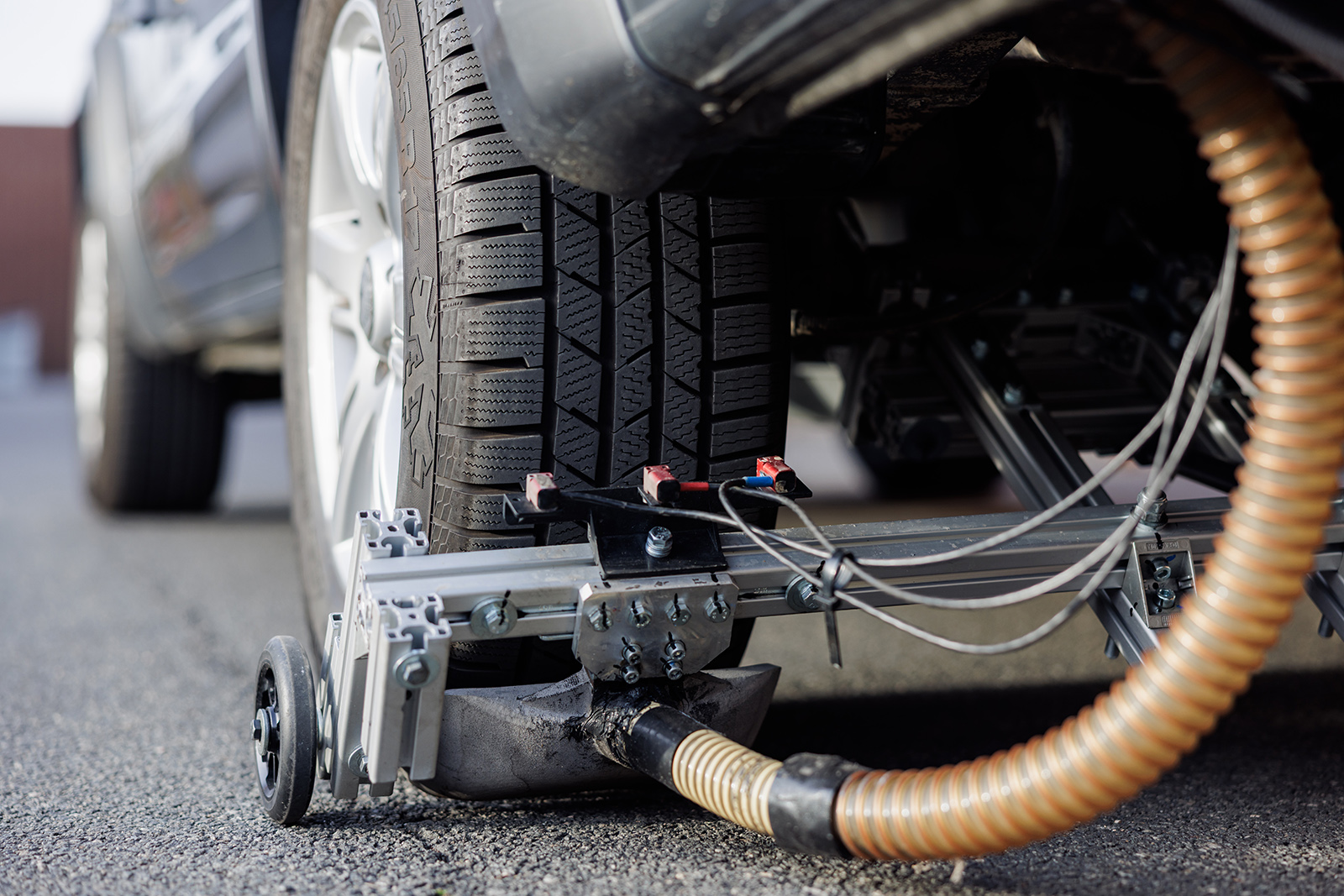
The system consists of a vacuum device mounted directly behind a driven wheel at road level to literally suck up particles. In conjunction with advanced particle sensors, the kit can detect even the finest of airborne particles behind the wheels and the system can work out whether the particles come from the tyres, the road surface or the brakes.
The data is then correlated with other factors such as driving dynamics, surface and weather conditions.
Michelin released details of a vacuum system for measuring small emitted particles from tyres in 2024 and Continental more recently gave some insight into a project completed at the end of last year called ‘Online analysis of airborne tyre wear particles at the point of origin and differentiation from other sources’, or OLRAP for short.
It has also developed a technique with the Technical University of Braunschweig for accurately measuring tyre wear and the generation of airborne particles.
The data collected by the system includes details of the quantity, size and structure of particles and is fed back into Continental’s tyre development programme to optimise tyre design and compound formulation more precisely.
The latest ‘multisampler device’ enables the capture of particles relating to specific types of driving, separating those collected when cornering from those while driving in a straight line, for example. The research team says it identified clear correlations between particle concentration and speed profiles as well as the effect of longitudinal and lateral acceleration on tyre wear.
Ultimately, reducing particulate levels from tyre and road wear will not be allowed to compromise safety and, as Continental points out, the tyre’s primary job is to “transfer vehicle forces”.
Grip is achieved through friction and that inevitably leads to wear of both tyre and road surface. A certain level is unavoidable to ensure safety-critical features remain uncompromised.
 By
By