
The safety concept of vehicles communicating with each other and the surrounding infrastructure has been under development in Europe for more than 20 years. Now it has come of age.
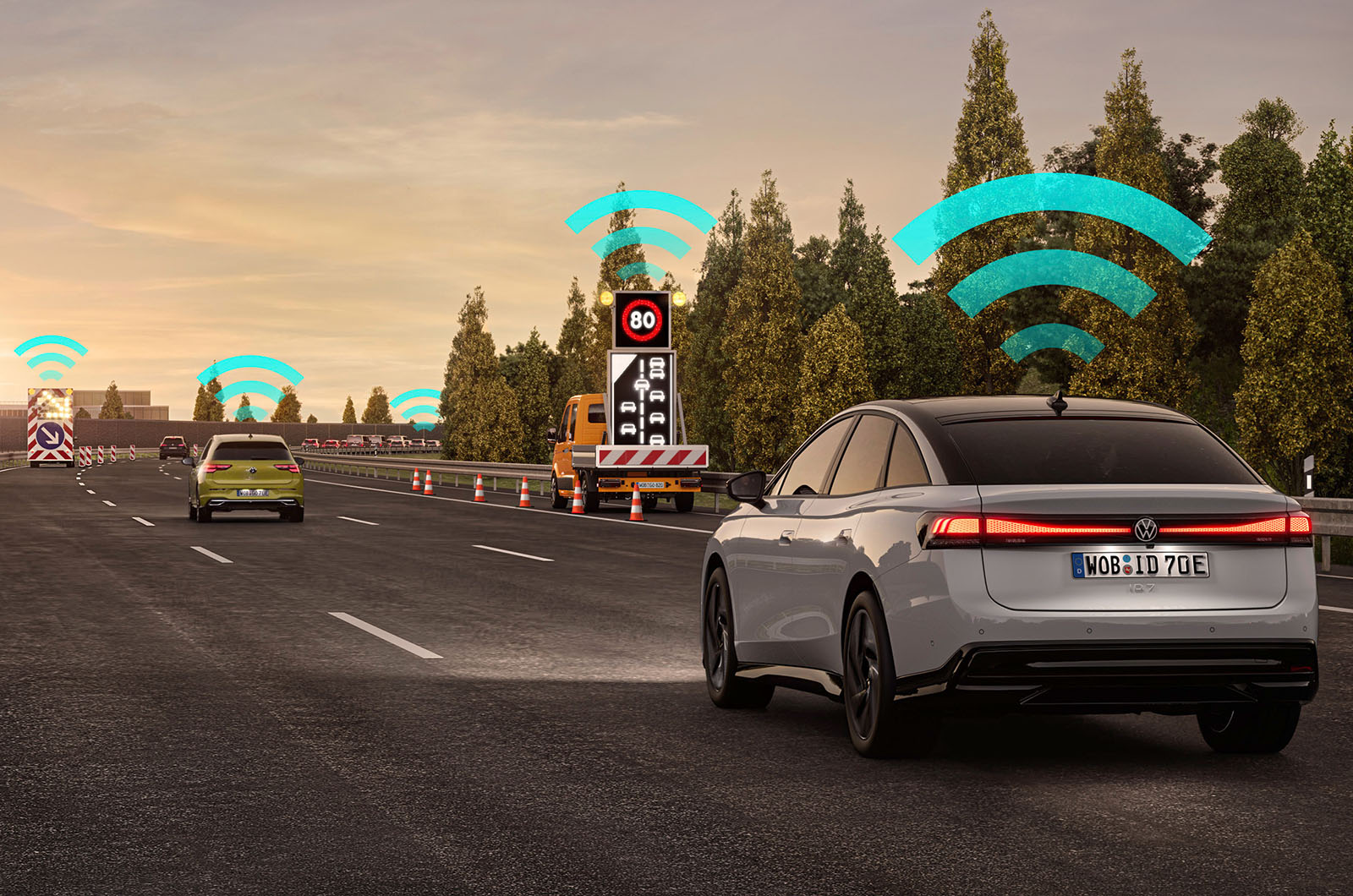
Volkswagen says more than two million of its vehicles have ‘Car2X’ technology, which enables them to take advantage of “local swarm intelligence”, warning of traffic hazards and other relevant factors.
It is available as standard or an option in a range of VWs, including the Golf, T-Roc, Tiguan, Tayron, Passat, ID 3, ID 4, ID 5 and ID 7.
In the noughties, there were a number of European projects working on what then was known as V2V (vehicle to vehicle), often supported by major car makers and the electronics sector. The principle of the original V2V concept was simple enough: to harness low-cost wireless local area network hardware that was already widely in use.
With bespoke software, the operating range was 500 metres and vehicles were able to join and leave ad hoc peer-to-peer networks consisting of a number of vehicles in range of one another on a random basis. In that way, each car was networking only with vehicles immediately relevant to it.
VW’s Car2X-capable vehicles can communicate between themselves and the infrastructure and no mobile network reception is needed to do it.
The communications take milliseconds, so a vehicle is instantly warned of emergency braking by a vehicle ahead, a traffic queue suddenly appearing or the approach of emergency vehicles from any direction.
Connecting to infrastructure such as intelligent roadside units as well as other vehicles allows warning of specific events like drivers heading the wrong way on a street or carriageway, traffic jams, unusual weather conditions, or people, animals and objects in the road.
In Germany, 1000 roadwork trailers have already been equipped with Car2X technology and roadside units are in place across Austria’s motorway network. Other European countries are following suit with roadside units and emergency and special vehicles.
Car2X technology operates on the ‘wi-fi standard, which enables vehicles to exchange warnings at a range of 800 metres. The notification process is open and standardised, allowing communication across all manufacturers’ vehicles. There’s no individual identification and exchanges are anonymous.
The system can interact with other vehicle sensors. For instance, with VW’s optional Travel Assist with ACC, Car2X could reduce the vehicle’s speed when it detects a traffic queue ahead that isn’t yet visible. It can also help control acceleration in assisted lane-change manoeuvres.
Volkswagen expects other types of vehicles to be included in Car2X, including motorcycles, trucks, buses and bicycles.
 By
By