
Back in 2010 or so, when Android was still trying to establish itself as a worldwide mobile platform, I took a leap and bought a tiny, cheap Samsung Galaxy 5 (not S) to test the waters. I fell in love with the Android Market, the idea of home screen widgets, the powerful multitasking, but most of all, I fell in love with what Android represented: freedom, openness, and choice.
Today, in 2026, countless phones and brands later, having tested thousands of apps and tricks, and written even more articles about the platform, the image that I have of Android is so different that I don’t recognize it anymore. The recent sideloading restrictions felt like the last dagger into my old and outdated vision of Android. Maybe I should let go of my nostalgia and embrace what this new Android is all about?
Which version and vision of Android do you prefer?
3 votes
What made me fall in love with Android is all but gone

In the early 2010s, Android was the rebels’ platform — a perfect playing ground for whatever you wanted to do on your smartphone. There was no one-size-fits-all rectangular glass slab, but myriad shapes and form factors. My favorite was my HTC Desire Z, a sliding phone that revealed a full QWERTY keyboard in landscape mode. It was a joy to type on, and the Z-hinge was a satisfying feat of over-engineering. Ch-KLICK! Qwerty mode on! It made me feel like I was carrying a Transformer in my pocket. Nowadays, the most excitement I get is from slapping a magnetic accessory on my Pixel 10 Pro XL. Not the same thing.
Beyond form factors, Android hardware often brought interesting innovations. microSD slot expansion, 3.5mm headphone jack, customizable LED notification lights, IR blasters to control nearby TVs or other electronics, and modular designs; there was something new to explore every year, if not every few months. I still remember messing up my college professors’ presentations with the “secret remote” in my phone. Today’s foldable phones and tri-folds are impressive feats of engineering, but they somehow don’t bring me the same joy as plugging an iblazr camera flash (a funky old Kickstarter project) into the headphone port of my LG G5.
Software was another huge expression of freedom and choice on Android. From Titanium Backup to SuperSU, Xposed Framework, Greenify, Chainfire3D, Cerebrus, and Viper4Android, there were so many legendary hardcore geeky tools that let me push my phone beyond its limits and beyond what Google allowed.
I fell in love with the unrestrained version of Android and its unlimited hardware and software freedoms. All of them are gone.
No matter where I found an app, be it the Android Market, XDA Forums, or some enthusiast’s GitHub, I could grab the APK file and install it. It didn’t matter if my phone was rooted, had an unlocked bootloader, or was running a wholly unsanctioned custom ROM. There was no SafetyNet, no Play Integrity, and no Play Protect. It was the wild west, and it was beautiful and free. When HTC stopped updating the Desire Z, I went through a gloriously traumatizing three-hour rooting process that involved “forking children” in the phone’s terminal to install a stock Ice Cream Sandwich ROM, a custom kernel, and multiple mods on top of that. In comparison, Google today wants you to enable Developer options and wait 24 hours before you install an unverified app. Oh, how the times have changed.
Long before Scoped Storage was a thing, you could access any file from any app. I used that to copy and save game progress files from phone to phone, back up and restore downloaded music and podcasts (I was living on a very expensive and slow internet connection then), and access any random files I needed from various apps. Now, when I use my favorite writing app Jotterpad, I can’t even access the .txt files directly.
And long before app permissions and restrictions were so pervasive, apps could do more, especially with accessibility services. There was a time when Tasker could “see” any button on your screen, even from other apps, and click it for you. People used it to trigger the “skip ad” button on YouTube the moment it showed up. Hacky but fun apps like this used to be the norm; now, they’re an exception that’s too messy to bother with.
That was also the golden age of AOSP. The “stock” experience was the core part of Android, and all of Google’s development and focus went into it. Android had built-in apps for the phone dialer, contacts, browser, calculator, clock, file browser, and more. Today, those are Google apps, and AOSP is becoming a hollow shell. Meaningful innovation happens in Google’s apps and Play Services (as well as the Pixel UI), forcing every phone manufacturer to pay Google the price of entry. It’s time to face the music: Android isn’t really an open-source community project anymore; it’s a Google product that just happens to use the Linux kernel.
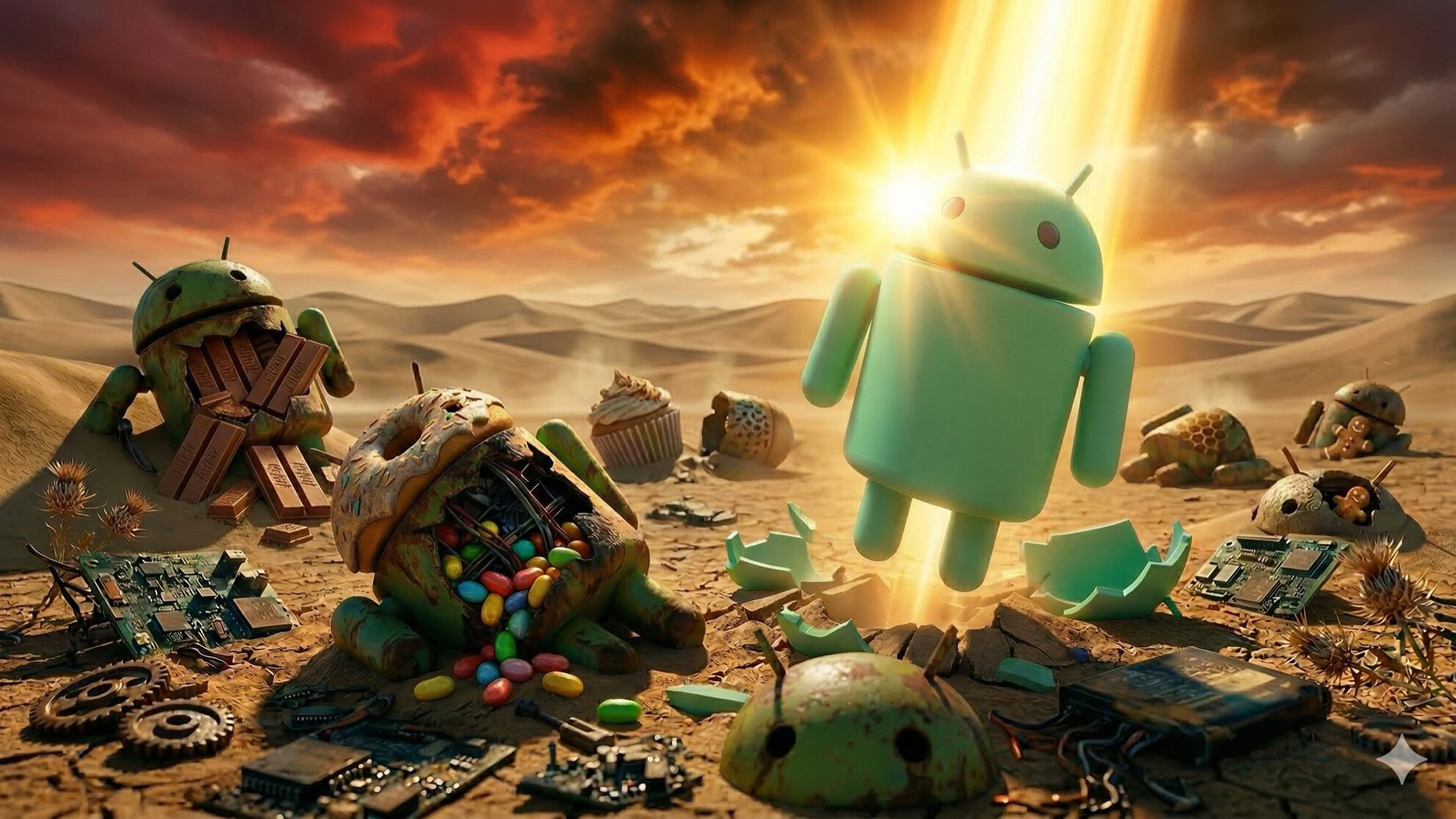
From the corpses of old Androids, a new Android has risen

Rita El Khoury / Android Authority
Android has followed a very logical, if not often loved, trajectory throughout its 18 years of existence. Its early days were chaotic and wild, but extremely free and fun. There were no limits and no virtual walls stopping you from tinkering and doing what you wanted to do. It embodied a lot of the openness of Linux while providing a more user-friendly platform for those who didn’t want to bother too much. Things couldn’t stay like that, though.
The more Android became popular, the more its responsibilities grew. This is no longer the enthusiast platform used by geeky tinkerers like you and me in the early 2010s, but an operating system that powers billions of people’s phones in the mid-2020s. And for most people, a phone isn’t an accessory anymore, it’s an always-on vault that carries everything they care about. Personal photos, banking and financial information, health history, work contacts and apps, family communications, important documents, travel details, and access to all the services we use daily pass through our phones.
When billions of people access crucial data on their phones, the responsibility balance changes and Android’s old wild west rules can’t apply anymore.
From my grocery store app to Spotify, from my bank card in Wallet to my daily commute card, from YouTube to Uber, Deliveroo, Plex, and Instagram, my phone knows more about me than I do, maybe. When so much personal and serious information is at stake, and for billions of people around the world, the wild west rules can’t apply anymore. I fully understand that. The Android that I fell in love with was a victim of its own success, and the version we have now is the direct result of Android being this popular and this powerful.
When my colleague Adamya interviewed Sameer Samat, President of the Android Ecosystem, he said two very important sentences that embody the responsibility of developing a platform as large and as beloved as Android: “If the platform doesn’t protect vulnerable users, it won’t be successful […] And if it doesn’t honor openness, it also won’t be successful.”
If I look back at the last 18 years of Android, I can see this ethos in every tug-of-war decision that Google has implemented on the platform. Accessibility restrictions, permissions galore, Scoped Storage, Play Integrity, Play Protect, and even the more recent sideloading rules — I hated the inconvenience of all of these for my own use, but I can’t imagine recommending an Android phone to my parents or my non-techy friends today if they didn’t exist. I’m willing to pay the price of a more restricted Android for me, the nerd who knows what she’s doing and wants all the freedom, if it means it’s safer for millions of less savvy users around the world.
I’m willing to pay the price of a more restrictive Android for me if it means it’s safer for millions of less savvy users around the world.
My colleague Stephen agrees with me. He, too, appreciates the new sideloading rules as a guardrail against scammy apps and unsuspecting users. “Android is defaulting to making everyone enter through the kiddie pool. If you want to swim out deeper, that’s on you.”
This embodies the new Android that has arisen in the last few years. It’s full of restrictions and protections, as it should be for a platform of this size and this responsibility. There are still menus, settings, tricks, and backdoors to do what you want if you really want to do it. Openness is still part of Android, but it’s hidden under layers of red tape that only the most staunch users will dare cut. I’ve personally made my peace with it. I’d rather know my dad’s data is safe on his phone, even if I have to “suffer” by tapping a few extra buttons here and there and waiting 24 hours to download an app.
Now, if only Google could put this much effort into stopping scammy apps from making it onto the Play Store and bypassing all these restrictions…
Don’t want to miss the best from Android Authority?


Thank you for being part of our community. Read our Comment Policy before posting.
 By
By