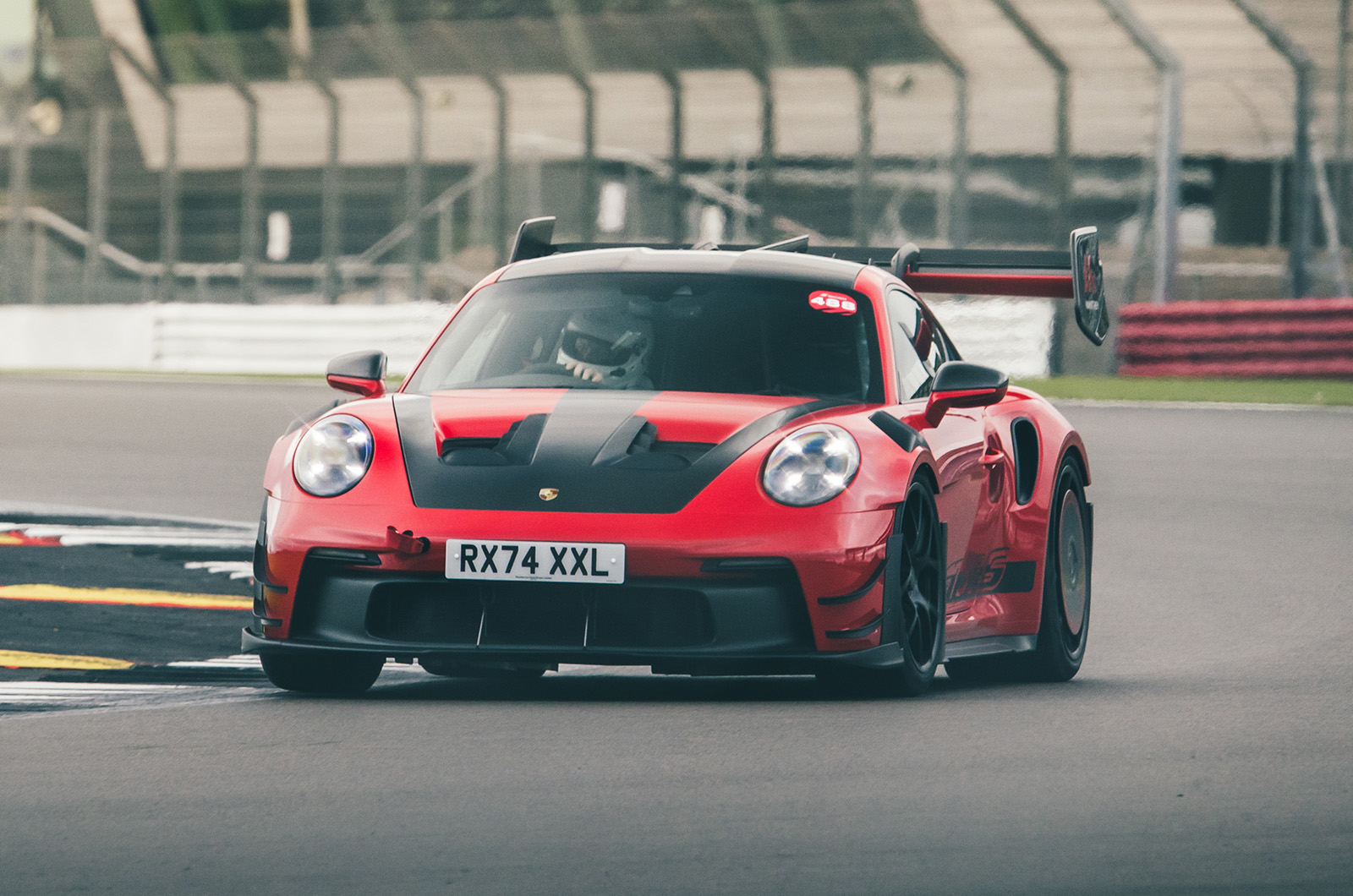

Silverstone is the ideal place for exploring the limits of grip in a car like this, with triple-figure transitions and corners that never end.
Subjectively, though, it’s a close-run thing. The ability of both cars to contain the yaw impulse of their heavy tails during trail-braking, without killing rotation entirely, is something special. It’s just that the Manthey will tolerate more ambitious turn-in, its ability to inspire confidence being just a little greater. The normal 3RS feels like an amped-up road car, while the Manthey sticks like a declassified racing car.
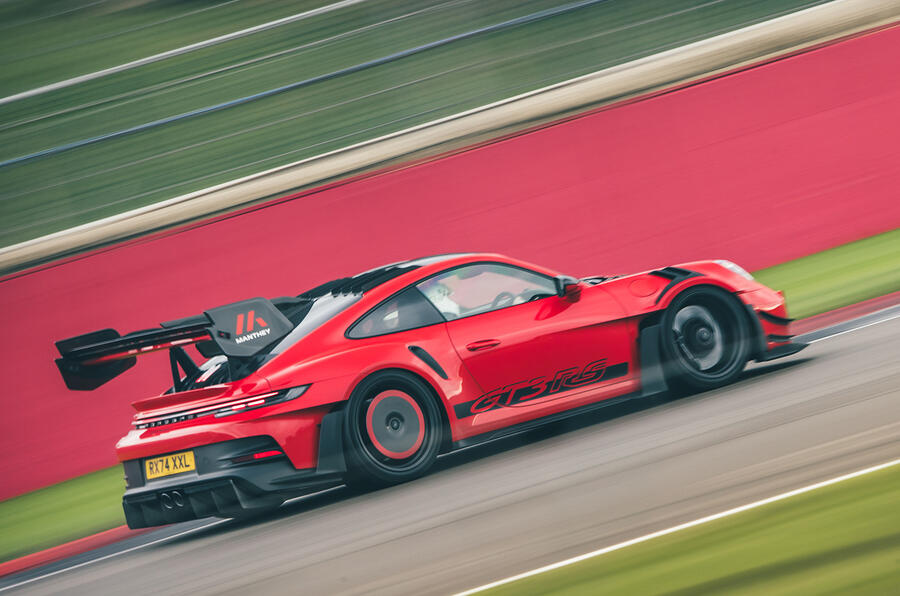
In the end, it puts in a 2min 15sec lap 1.95sec quicker. Checking over the telemetry, the Manthey’s advantage is in its ability to carry a couple of extra miles per hour on the exit kerbs of faster bends like Farm, and carry more speed into the rollercoaster Maggotts-Becketts sequence. Outright braking distances aren’t notably shorter, interestingly.
Clearly, the Manthey allows you to draw more speed to the apex. During huge sweeping bends, where your senses are on red alert for the early signs of grip eking away at either axle, it also simply holds on a little longer. And perhaps, for the amateur, it just encourages you to try wilder things, more of the time.
Would a professional have squeezed more or less time from the kit? The sliver of extra confidence the Manthey 3RS seems to give you, so useful to the amateur, would matter to them less. On the other hand, a pro driving on the true limit of adhesion would maximise the Manthey’s downforce advantage everywhere.

 By
By