
Written by Alexandra Fefopoulou | Photos by Stergios Gogos. Posted in Rides
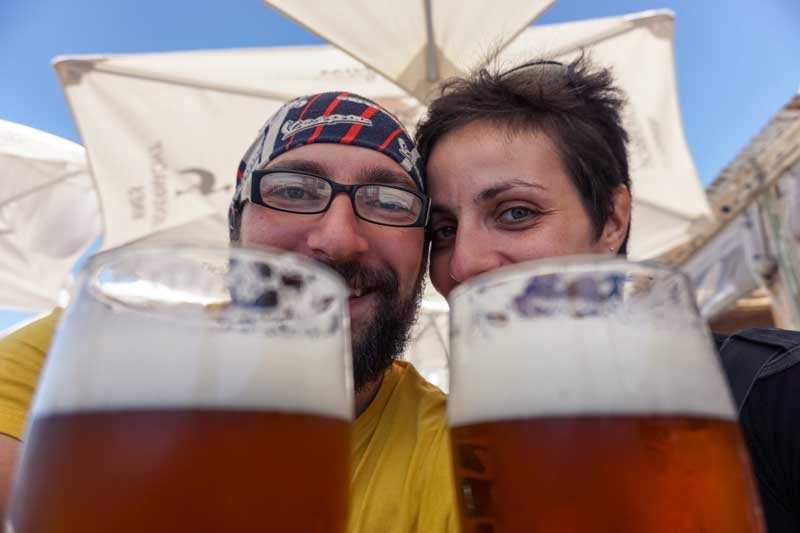
It was a hot summer evening, sitting with Stergios on our balcony in Athens sipping cold beer and chatting about our travels when a memory came back from years ago: our first beer together. We were in South Africa and had just left Joburg riding towards Lesotho. It was the first day of our trip together on a “test ride” because we hardly knew each other and didn’t know how things would go with two almost-strangers riding two-up on a Vespa. After a smooth first day on the road, we pitched our tent by a lake. The place was idyllic; after dinner, Stergios went to the store for a couple of beers and we drank them sitting next to each other enjoying the moment.
 Our first beer together! 24 July/
How many times do we say, “the first time I…” in our lives? Some are lucky enough to have a lifetime full of firsts, both big and small. That day, it was just a beer at a campsite somewhere in South Africa, but for us, it was the beginning of our story together, the first time I rode the Vespa and the first time Stergios traveled with a pillion.
When Stergios decided to leave everything behind to scooter through Africa, he didn’t think he was doing something special or breaking any record; he just wanted to see the world. Many first-time events, such as pitching his tent overlooking the Atlantic Ocean in Western Sahara, weren’t worth mentioning because wild camping for the first time was all about overcoming his fears and insecurities and nothing else.
We all grow up in different environments and our development often depends on that background. A Westerner may feel that life has little or less value in the developing world, that there is violence and hostility towards Americans or Europeans, and that people “in those countries” are different and don’t understand us. Despite all that, some decide to ignore what they’ve heard and venture off despite the alleged danger. Unlearning our biases is not necessarily an easy process. But it’s something most resist.
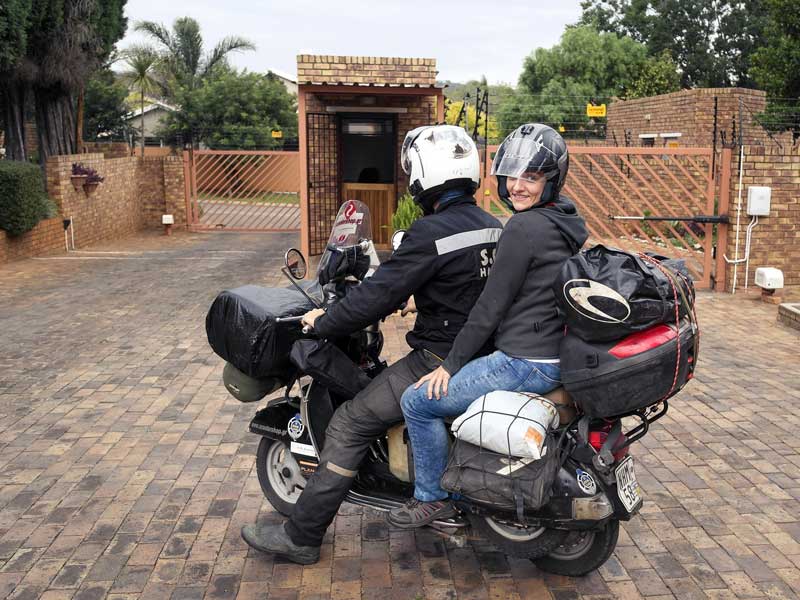 The first day of our trip. Leaving Joburg, having no idea that this was the beginning of our story together.
So, when Stergios got into his tent that first time, his fears made it difficult to sleep. “Will someone rob me?” “Will I be attacked?” However, the following morning, a group of fishermen gathered around who just wanted to offer him tea and were curious to learn his story. Later, in another incident of unfounded fear, it turned out that two Cameroonians who were shouting at him, were only trying to convince him to follow them—offering dinner and a safe place to pitch his tent next to their hut in the forest. A humble offer by complete strangers who didn’t want anything in return. An act of kindness, and nothing more. In many of these cultures, food is not just food, but a cultural exchange—a way to communicate and get closer to others, to break the ice. So, learning to say “yes” to such offers is a way to honor them and free up one’s perspective.
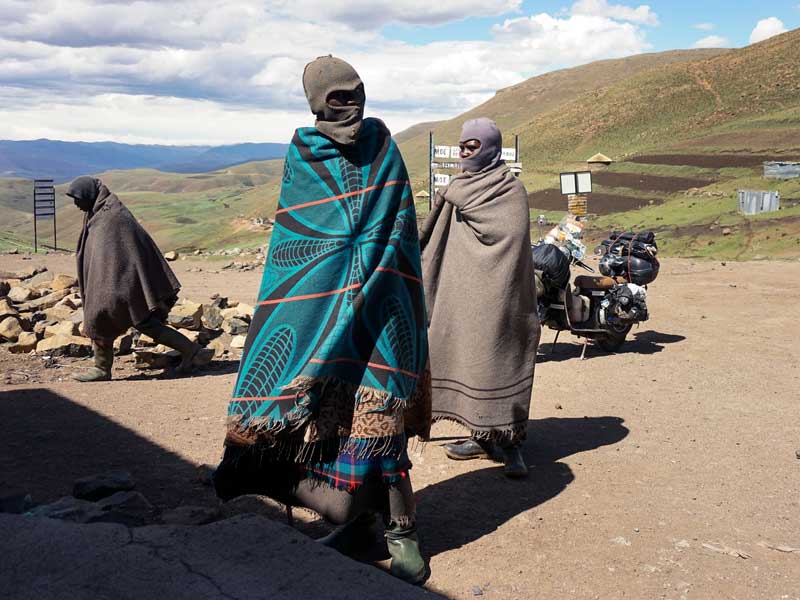 In Lesotho, people may seem unapproachable covered in their traditional woolen capes, but you need only a smile and a kind greeting for the ice to break.
Sometimes, there’s no other option than to trust a stranger. But what happens when there’s no other choice? When Stergios ran out of fuel in Mauritania crossing the Sahara Desert, a passerby told him that when he got to the next town he’d send someone with gas to meet him. It seemed impossible to believe him, but what else could he do? About 10 hours later a man approached with the promised fuel, explaining that he was the person the man had sent.
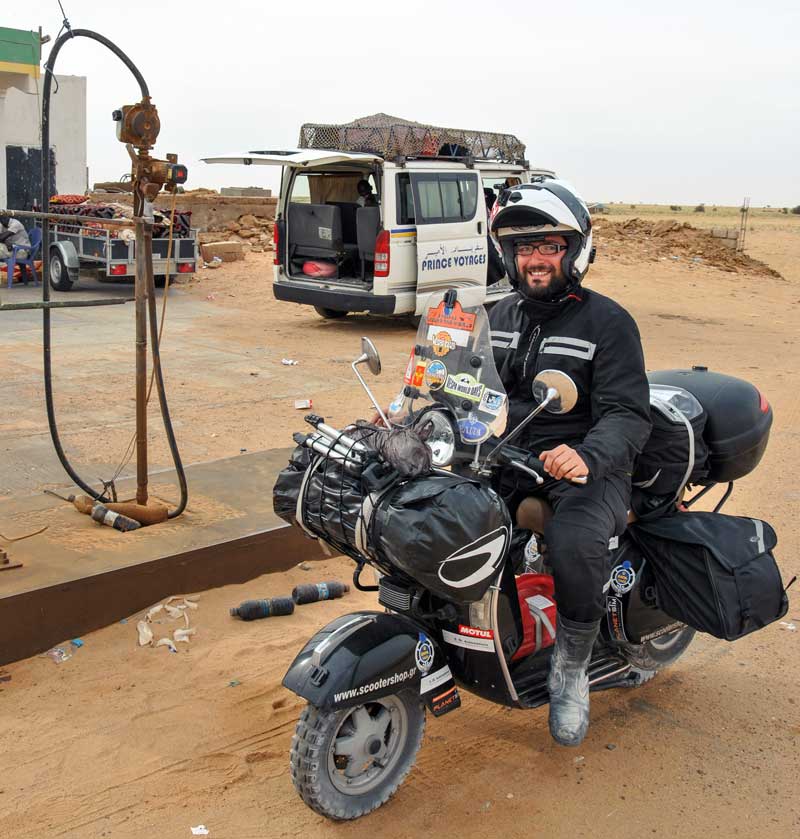 Having run out of gas somewhere in the Sahara Desert, the only option was to trust a stranger who promised that he’d send someone with a jerrycan. After 10 hours, he appeared!
And what about the unpleasant first times? I wish I could say that everything is idyllic, that all people are always great, and that nothing can go wrong, but that’s not the way it is. Accidents, robberies, and other misfortunes will all happen, too. In our case, we had an unpleasant first when we were almost robbed in downtown Johannesburg. The GPS had malfunctioned, so we stopped to sort out the problem. Suddenly, we were surrounded by suspicious types in hoodies. We immediately got out of there, but it was a close call and we chose to see it as a useful lesson. From that day, we decided not to lose trust in others but to always be a little more mindful.
We all tend to feel more comfortable when in control, preferring the ability to predict and anticipate what’s next. Conversely, we feel exposed and insecure when this seems impossible. The better organized the society, the more difficult it is to get out of our comfort and security zones. Vulnerability is widely regarded as a weakness—a situation no one enjoys—so why make the choice to abandon our security voluntarily?
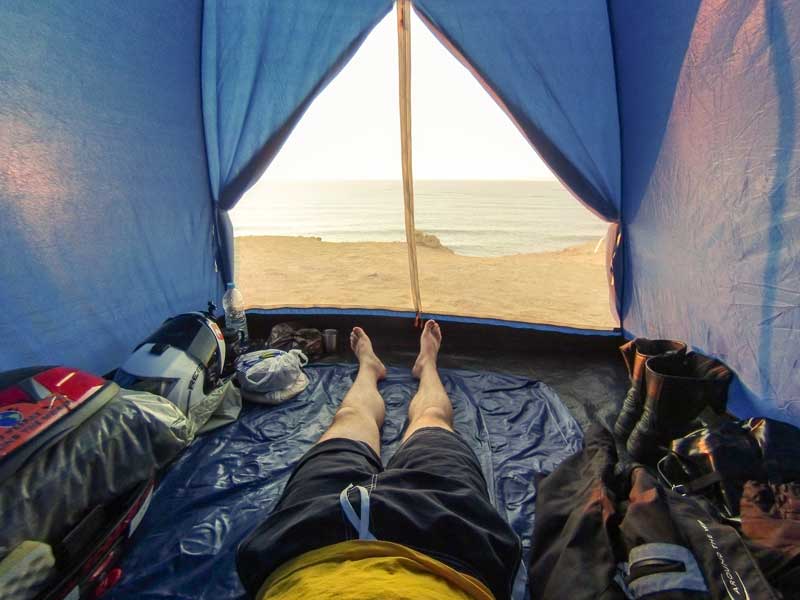 Stergios’ first wild camping, overlooking the Atlantic Ocean in the Western Sahara.
One answer to this is the sense of adventure. Security and control can be illusions, anyway—a fragile state that can change in a moment. And what happens if or when all we took for granted is lost? That depends on how prepared we are. An RTW, for instance, is a good way to play with the limits, where at some point the only choice is to let oneself lose control to see what happens.
When on the road, you forge ahead because the only other option is to go back. Travel is addictive, but it’s not always easy. At times it can be difficult. I still remember the difficulty we experienced the first time we asked permission to camp at a gas station in the middle of the Argentinian pampa. Now, after dozens of similar nights, we prefer it over other options we may have.
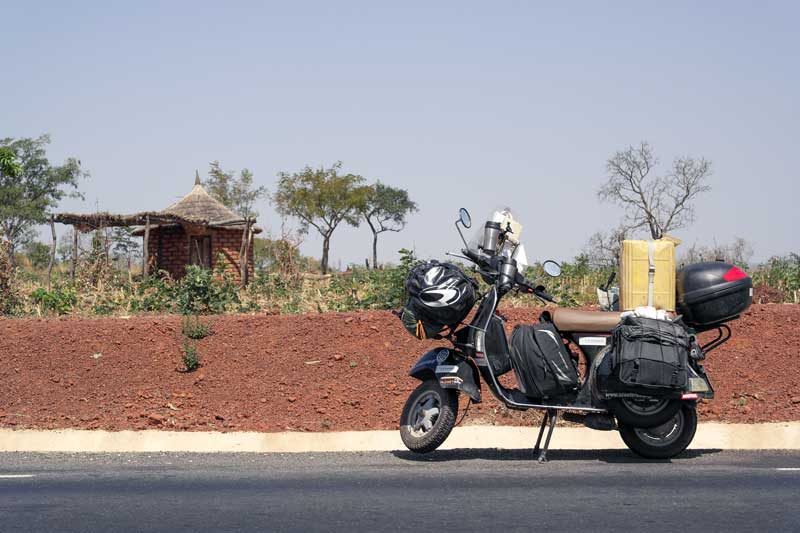 Senegal’s Niokolo Koba National Park was Stergios’ first time riding in the African savanna.
As one thing leads to another, we now find ourselves feeling comfortable in situations that once would have been unthinkable. So, when we were in a small town somewhere in rural Brazil, and a complete stranger invited us to stay at her home, we immediately nodded “yes.” After three years we’re still in contact with that lovely woman and her family who welcomed us into their home and treated us like old friends.
Although a long-term trip can be full of big life lessons, sometimes first times can be fun, with no deep meanings or big life lessons attached. Like the time when we agreed to go dancing at a local traditional fair in Brazil, or when we helped an Argentinian shepherd put his goats in their pen. Previously, we would have politely refused to make a fool of ourselves trying to follow the steps of traditional Brazilian dances publicly, and we would have definitely refused to take the risk of herding 300 goats into their pen. After our years on the road, we can now say that we are addicted to “first times”. Whether it’s something small, easy, and trivial, like a new taste—a food we did not think we could enjoy—or something more important, such as a decision that can change our lives or the way we look at things.
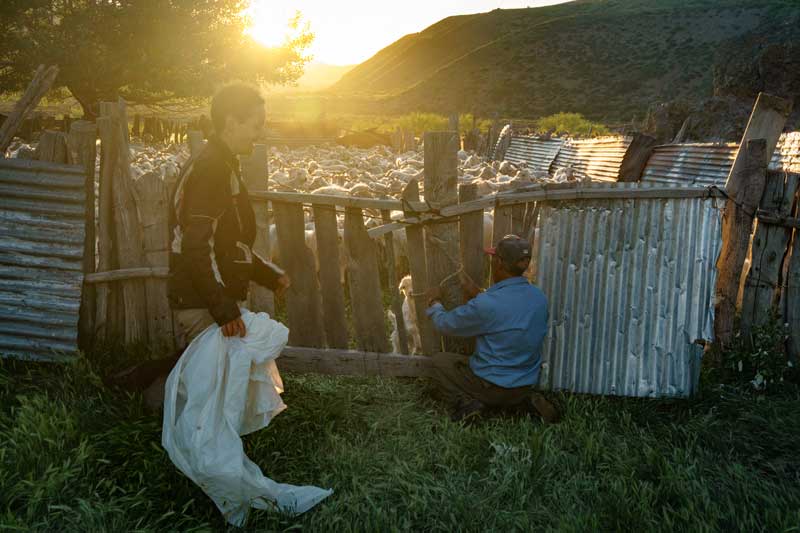 Another first for us: we helped an Argentinian shepherd put his 300 goats in their pen!
So, what is the thing that makes an RTW trip so unique for those who choose to do it? I would say that it’s the dots we connect to form the pattern of our lives: all these first times that we’ll always remember.
 Stergios and Alexandra first met in 2014 in the Democratic Republic of Congo while Stergios was on his RTW, and Alexandra was doing Ph.D. fieldwork. Since then, they’ve been traveling together. They write, film, photograph, and ride their vintage Vespa scooter around the world, combining their passions—and have recently released their first book “Rice & Dirt: Across Africa on a Vespa”. WorldVespa.net
 By
By