

Adamya Sharma / Android Authority
TL;DR
- Samsung has showcased its future smartphone screen technology at MWC 2026.
- The LEAD 2.0 displays are brighter and more saturated than current panels, and require minimal bezels.
Display technology is one of the many checklist items that smartphone companies are fervently developing and improving. This means pushing the boundaries of efficiency, luminance, and definition. Samsung is one of the firms at the forefront of this effort, and at MWC 2026, it showcased its LEAD 2.0 technology, which could make its way into future smartphones.
Do you think current smartphone screens are bright enough?
13 votes
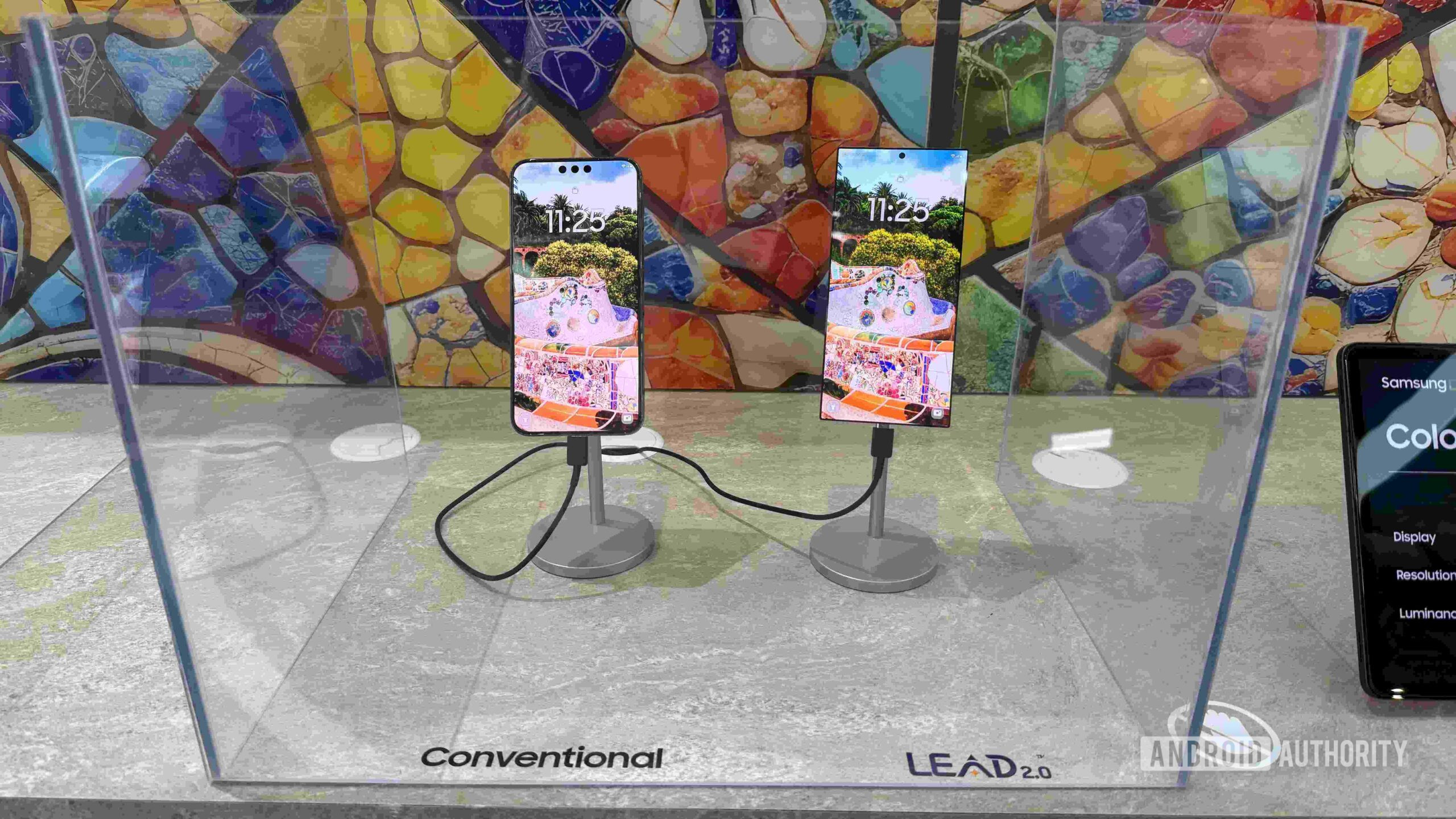
We got a first-hand glimpse of these new panels in action, and it certainly passes the eye test. Compared to Samsung’s “conventional” OLED displays, the new panels appear far brighter and much crisper — despite packing a lower pixel-per-inch value — with higher dynamic range and saturation levels, as seen across several promotional reels.
Specs displayed suggest the new panel can reach a maximum luminance of 5,000 nits, far surpassing the current Galaxy S26 Ultra‘s 2,600 nits limit.

Adamya Sharma / Android Authority
These panels were also staged in devices with extremely thin bezels, suggesting potential future applications in near-bezel-less smartphones.
Of course, viewing stills snapped after the fact doesn’t quite do this showcase justice, but you can see the differences between the older and LEAD 2.0 technologies below.

Adamya Sharma / Android Authority
Samsung continues to innovate on the display front, with its most noticeable development landing on the Galaxy S26 Ultra. The new flagship’s Privacy Display obfuscates the screen’s content at sharp angles. Thankfully, with the LEAD 2.0 panels, it appears the company is still committed to pushing the boundaries of visual fidelity, too.
Don’t want to miss the best from Android Authority?


Thank you for being part of our community. Read our Comment Policy before posting.
 By
By