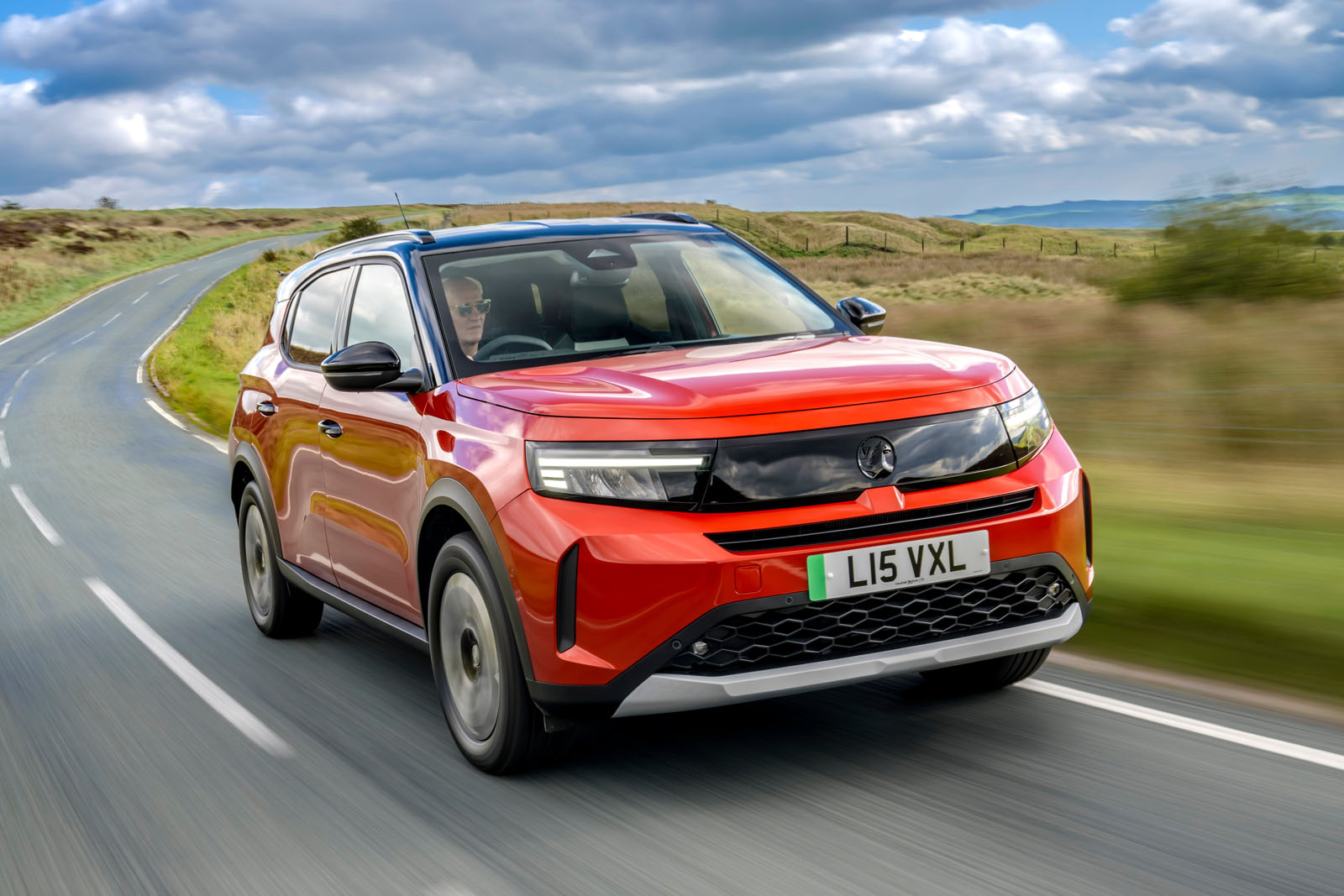

At 4310mm, the Frontera is close to 100mm longer than the old Crossland, although it’s broadly the same width (1795mm) and height (1635mm).
It’s basically the same length as the Astra, then, so Vauxhall rightly claims it has moved from the larger end of the B-SUV market into the smaller end of the larger C-SUV market.
Sure, that’s mostly marketing semantics, but it’s a mark of Vauxhall’s hopes for this car: it joins the larger and plusher new Grandland SUV in a two-pronged assault on the UK’s biggest car-market segment.
While the Grandland Electric is aiming for the higher end of the market, the Frontera Electric is firmly targeting cost-conscious buyers, not least with an eyebrow-raising starting price.
It’s slightly pricer than the 5, but it’s a notably bigger car. In fact, there aren’t all that many EVs in this segment on the market. It’s close in size to the Hyundai Kona Electric but significantly cheaper, and it undercuts the Kia EV3 (although that offers significantly more range).
Interestingly for Vauxhall, it also costs less than both the smaller Corsa and Mokka EVs. Those are more ‘design-focused’ cars with more premium features, but you can imagine the Frontera being plenty good enough for many.
The Frontera follows the new Citroën C3 in being based on Stellantis’s new Smart Car platform, which was designed with a strong focus on cost efficiencies, effectively being a basic entry-level platform scaled up. The powertrains are also familiar from the French crossover.
Stellantis’s ‘M2’ synchronous electric motor gives the front wheels 111bhp and 192lb ft of torque, while energy comes from a 44kWh battery. Official consumption is 3.4mpkWh, giving a range of 189 miles, but you can also opt for a 54kWh battery offering 253 miles.
These batteries use lithium-iron-phosphate chemistry, making them cheaper to produce and longer-lasting than nickel-manganese-cobalt batteries but slower to charge (the peak rate is 100kW) and more affected by cold weather.
 By
By