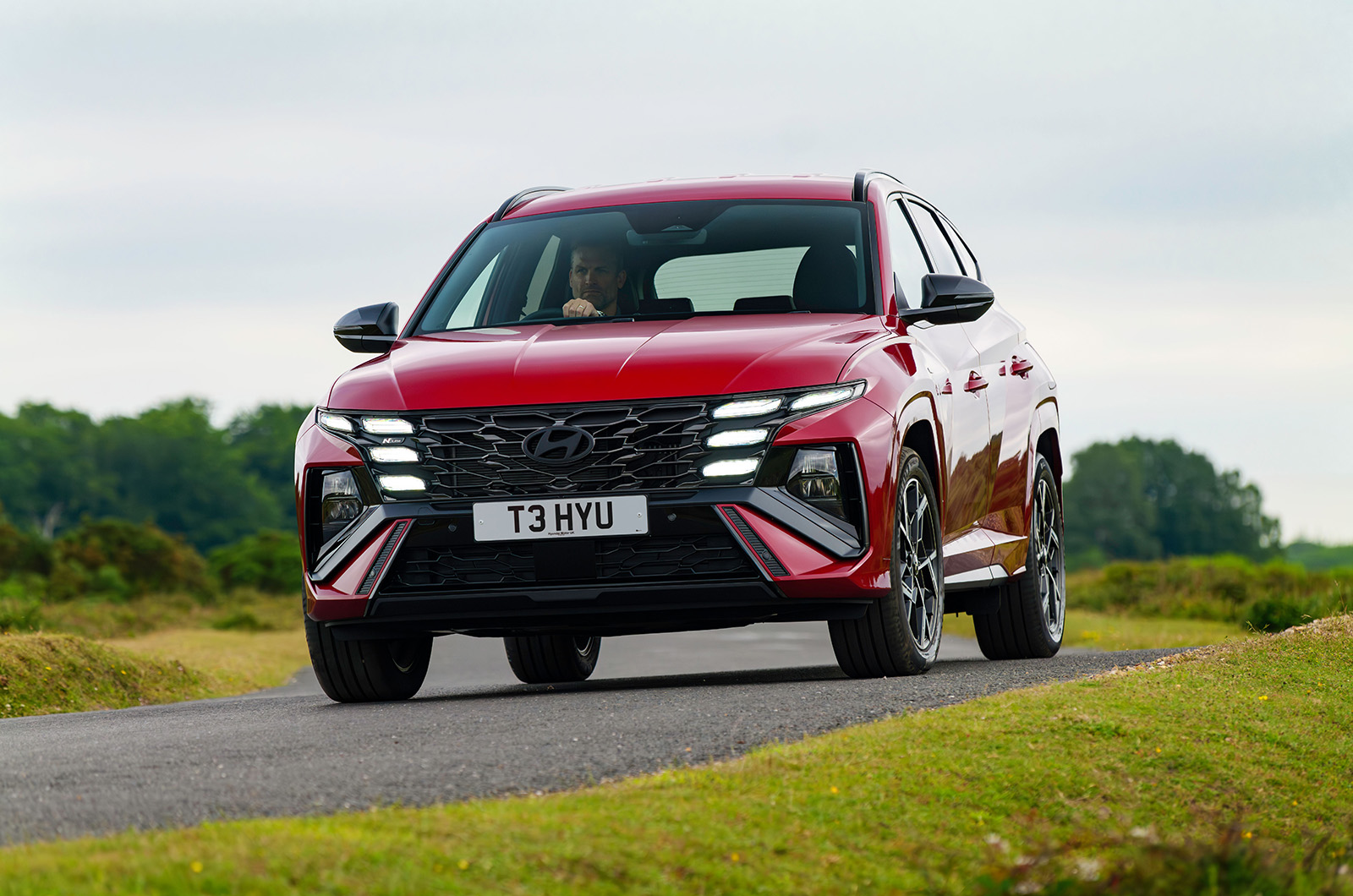

The self-charging Hybrid is the big seller within the range, so that’s the one we’re focusing on. It starts at a little over £36,000, so about £3000 more than the manual petrol, or £1500 more than the mild-hybrid.
The plug-in hybrid starts at £39,500 and is best suited to company car drivers because of its 14% benefit in kind rating, which is half that of the other powertrain options. However, because of its middling 44-mile all-electric range, rivals like the Volkswagen Tiguan eHybrid and Renault Rafale are worth a look – both can do more than 65 miles on a charge, saving on fuel and BIK bills.
Despite a range of updates in 2026 focused on improving efficiency and driveability, the powertrain remains the Tucson Hybrid’s only real weak point.
Over a rural test route it averaged just 40mpg, having barely managed 35mpg on the motorway (the engine is turning at 2400rpm at a little over 70mph). It certainly won’t impress anyone coming out of a diesel.
Speaking of which, the Skoda Karoq, Volkswagen Tiguan and Mazda CX-60, which is admittedly more expensive, still offer punchy and frugal diesel options.
Also, the throttle calibration invites too much torque from the electric motor within the first quarter of pedal travel, so it’s far too easy to spin the wheels in the damp and cause unpleasant tramping.
The system is at least smooth and well-integrated once on the move, if a little gruff when cold – an improvement from before. Overall, though, a Honda Z-RV will be smoother and more efficient more of the time.
Performance is adequate: it doesn’t have the vigour you might expect from the headline power figure but never feels short of grunt. We recorded a 7.6sec 0-62mph time on Millbrook’s damp one-mile straight.
Overall, the Hybrid isn’t worth the extra outlay over the standard manual petrol, but if you’re looking for a little extra performance and an automatic gearbox, it’s a more manageable step up from the mild hybrid.
In PHEV guise, the Tucson produces 247bhp and 271lb ft, but this increase in power is also impacted by an increased kerb weight of 1924kg. Its 8.1sec sprint from 0-62mph is respectable, and you will notice the PHEV’s strong, motor-enabled throttle response and smooth power delivery.
The brakes provide decent stopping power and pedal feel, with the Tucson needing a reasonable 54.1m to come to a standstill from 70mph.
There are steering-wheel paddles on Tuscons with automatic gearboxes, but they’re a little slow on the uptake and will only really be useful for those towing.
Hybrid and PHEV cars in top-spec N-Line S and Ultimate trims are available with with four-wheel drive, but it does further rob from the efficiency of the set-up.
 By
By