
Written by Utkarsh Sood | Photos by TVS. Posted in Bikes
Often in the world of motorcycles, we’re told that more horsepower equals more fun. That formula has more or less faded with time when you consider the number of small‑bore single‑cylinder motorcycles that have popped up recently.
In the adventure segment, particularly, that has been even more prominent – the Royal Enfield Himalayan, CFMoto Ibex 450, KTM 390 Adventure, and recently-revealed Kawasaki KLE 500 are some of the best options in the sub-500cc ADV class.
Dig deeper and you’ll find the likes of the Honda CRF300L Rally and Kawasaki Versys-X 300 offering solid specs for even more beginner-friendly attributes. Now, with the launch of the TVS RTX 300, there’s another credible competitor in there.
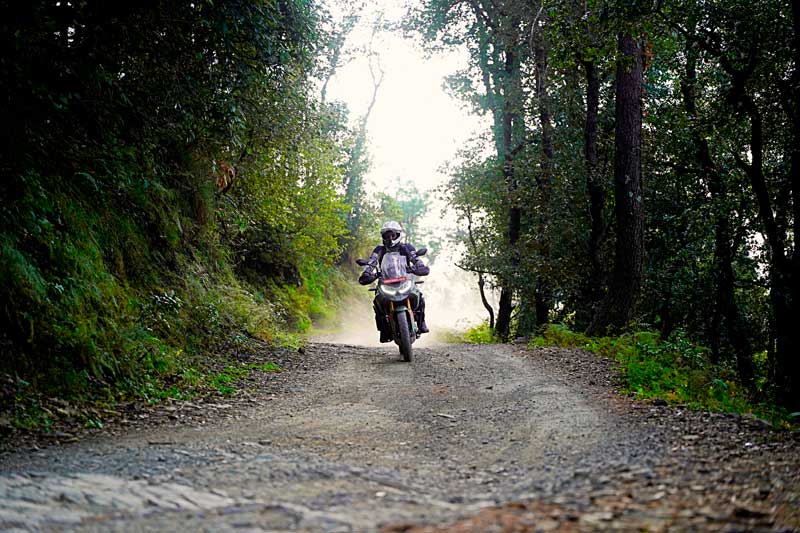
When TVS called me to ride the all‑new adventure tourer firsthand, even before it was released, I had to say yes. A crack at the company’s first‑ever adventure offering in the lap of the Indian Himalayas on some of the finest trails and dirt roads? How could I say no?
A short flight from Delhi to Chandigarh, and then a short bus ride to Fagu — a small hamlet just an hour away from Shimla, the capital of the state of Himachal Pradesh — and I was sitting under rolling clouds, watching TVS launch the exciting new RTX 300.
• All About TVS
Who is TVS, you ask? For most in the USA, TVS may be a relatively new name in the motorcycle world. However, in India and parts of Europe, it is a household name, having started operations over a century ago in 1911. Today, the motorcycle manufacturer has a global presence in more than 90 countries and five manufacturing facilities to accommodate demand.
Of the roughly 4 million two‑wheelers TVS produces every year, a major chunk are sub‑150cc scooters and commuter motorcycles, but it is the company’s “premium” category — the 300–310cc class — that is the most exciting. I’d know firsthand, having ridden the likes of the Apache RTR 310 naked and the Apache RR 310 sportbike around a test track earlier last month.
Add to that TVS’ partnership with BMW to build the G 310 RR, G 310 R, and G 310 GS, which expanded the Indian bikemaker’s horizons. That expertise is evident in the recently launched RTX 300, which features an entirely new 299.1cc single‑cylinder engine rather than the previous 310cc unit.
• Apache RTX 300 Motor
So let’s start there. The motorcycle is powered by a liquid‑cooled 299.1cc single‑cylinder, four‑stroke engine that delivers about 36 horsepower (36 PS) at 9,000 rpm and 28.5 Nm (about 21 lb‑ft) of peak torque at 7,000 rpm. The powertrain is coupled to a six‑speed transmission, an assist‑and‑slipper clutch, and a bi‑directional quickshifter to make shifting as simple as possible.
I loved that quickshifter for all of the 75 miles (120 km) we rode around trails, backcountry roads, and tarmac. I’d probably go as far as saying it is one of the best quickshifters I’ve used on bikes in this class.
The engine, too, holds its own, delivering plenty of torque across the rev range. My only gripe here would be how linear the power delivery is and how short the first two gears really are. But I do see the logic, considering a lot of riders will be maneuvering the motorcycle around the city quite a lot.
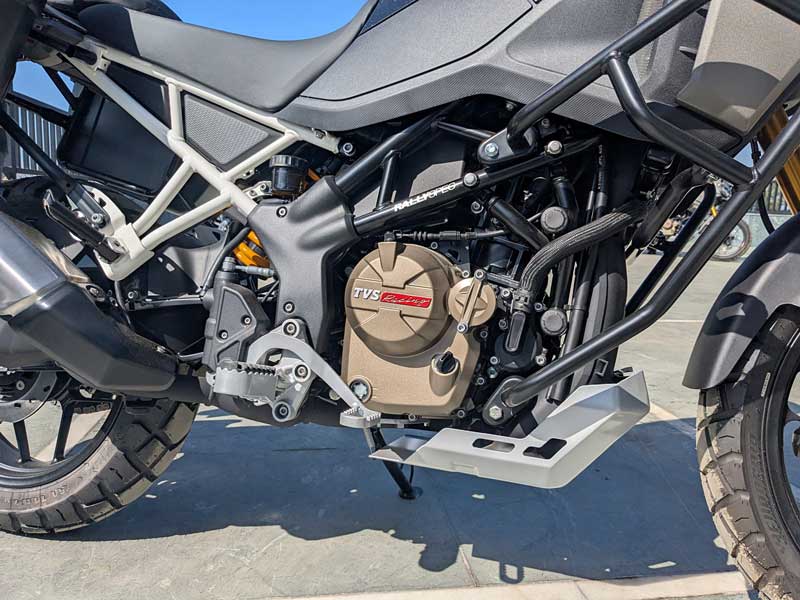
• Apache RTX 300 Underpinnings
That motor sits inside a steel‑trellis frame and a die‑cast aluminum swingarm. In case you’re wondering, RTX stands for Rally, Tourer, and Xtreme, all of which describe an adventure tourer rather than an all‑out hardcore adventure bike. This makes sense given that the bike rides on a 19‑inch front and 17‑inch rear wheel layout.
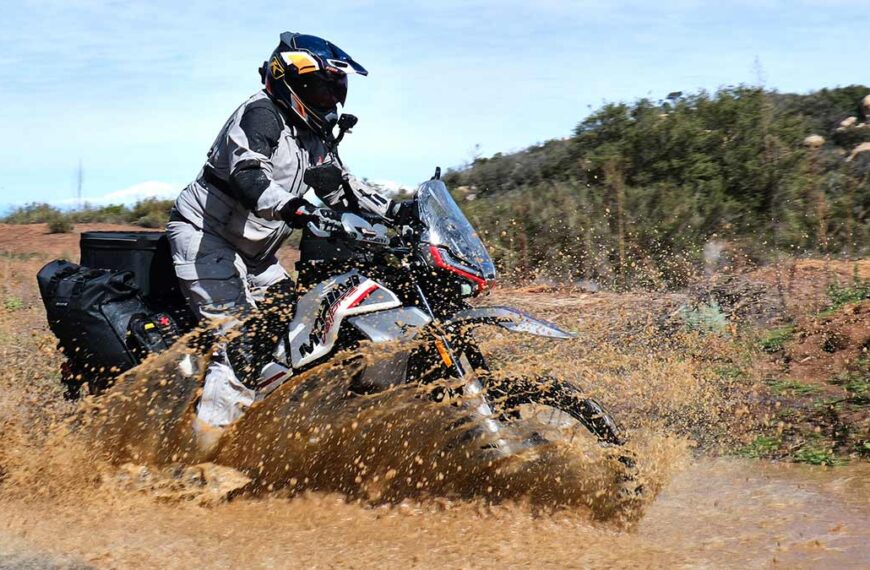
The suspension consists of 41 mm upside‑down, fully adjustable telescopic forks and a rear monoshock with a floating piston. Front and rear travel measure 7 inches (180 mm) each. I didn’t experience the bike bottoming out at either end, even though I tip the scale at around 200 lb (about 90 kg). And for a 300cc ADV to get gold forks, that’s something to love.
Down below, you get star‑shaped alloy wheels with special‑compound Eurogrip tires. For braking, there’s a 320 mm disc with a fixed caliper up front and a 240 mm disc with a floating caliper at the rear. Dual‑channel ABS is standard, with the rear being switchable.
Now, while the rear brake did feel a little lazy during my time on the RTX 300, I could get used to it. What I absolutely would tweak in my own ownership would be the extremely sharp front brake — I almost lifted the rear off on a couple of occasions.
The wheelbase stands at about 56.3 inches (around 1,430 mm), with ground clearance at 7.8 inches (200 mm) — all good here, with the earlier “78 inches” clearly a typo. At 32.8 inches (835 mm), the seat height didn’t seem like a concern for someone like me who’s 6 feet tall. But most riders looking at this segment probably will not be that tall, and that’s where they’ll have problems flat‑footing the bike.
Then there’s the curb weight of about 396 lb (180 kg). Is it the worst thing possible? Probably not, but the RTX 300 did feel a little front‑heavy, largely owing to the 3.3‑gallon (12.5‑liter) fuel tank. Adding some luggage or extra gear to the back might fix this problem relatively easily.
• Apache RTX 300 Features
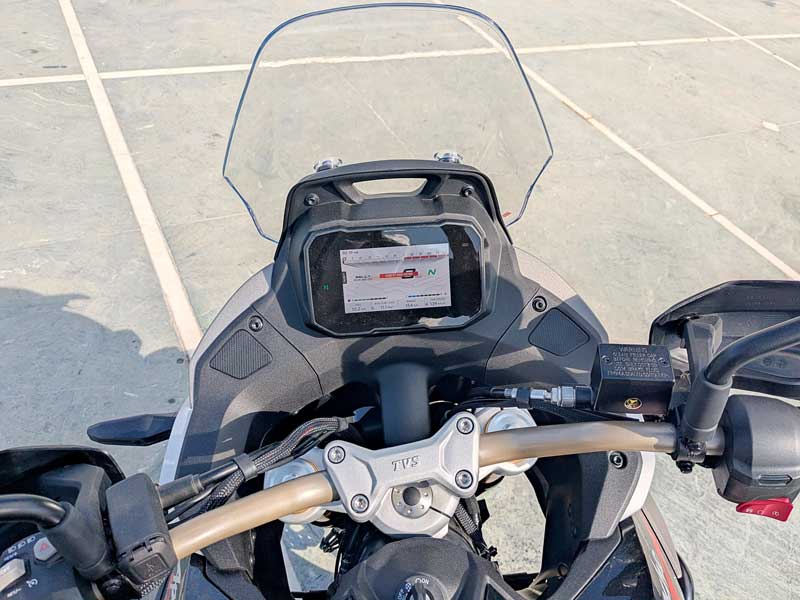
TVS has equipped the RTX with just about everything you could think of — a package it calls the RT‑LSC suite of electronics. You get four ride modes: Tour, Rally, Urban, and Rain. The electronic suite also includes Rally ABS, traction control, and cruise control.
All of this is controlled through a Bluetooth‑enabled 5‑inch TFT instrument cluster. It includes map mirroring with Google Maps, digital document transfer, TPMS (on the higher variants), and even the ability to manage your GoPro. TVS’ SmartXonnect app provides over 30 linked capabilities, marketed as “38+ features,” including last‑parked position.
What did I think of this suite of features? I liked them for the most part. My pick of the lot would be the 5‑inch screen that comes with adaptive brightness — perfect when you’re riding in varied conditions. What I didn’t particularly like was how the traction control seemed to intervene even when it was switched off. Could it be a small technical niggle? Possibly, and it seems like a simple fix that TVS should sort before deliveries begin in volume.
• Apache RTX 300 Design
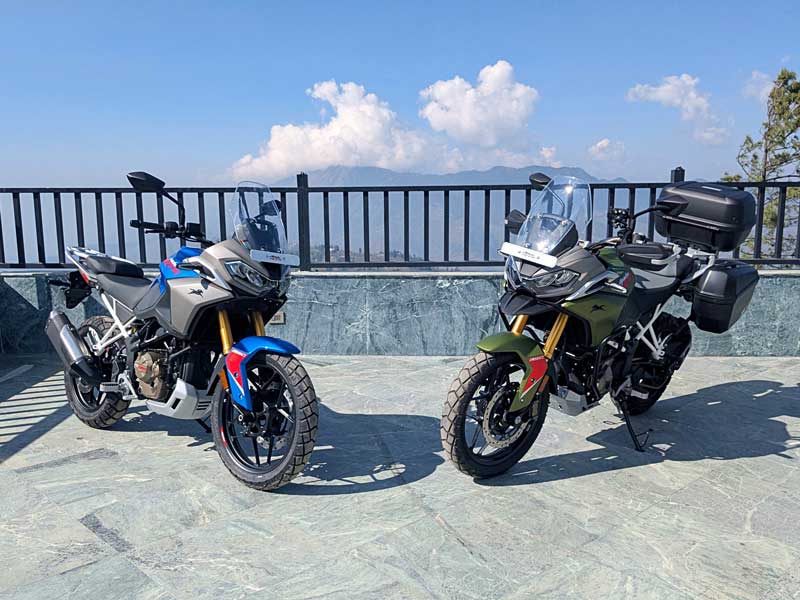
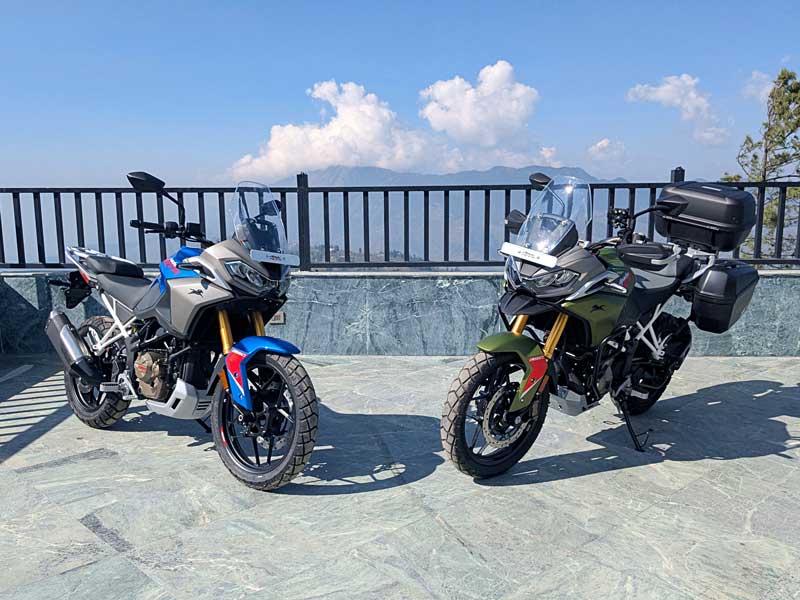
The RTX looks significantly bigger than other motorcycles in this class. The bike looks really good — definitely not what you’d expect a 300cc moto to look like.
There’s definitely a hint of Triumph Tiger and Honda Transalp in there for the keen‑eyed. It has a wide stance, which gives it plenty of road presence, thanks to the semi‑fairing with integrated twin LED headlamps.
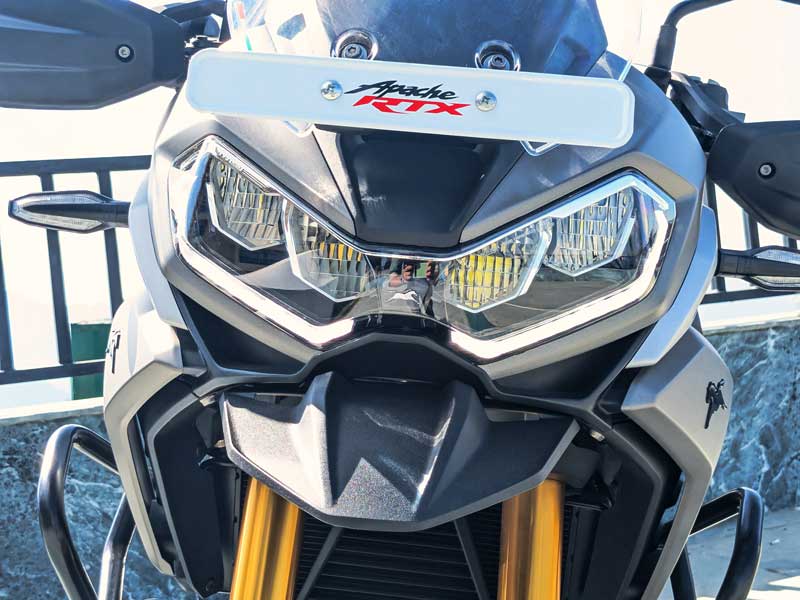
The bike features a split‑seat setup, a rear luggage rack, and crash bars for engine protection. A large windshield is handy, while the footpegs and handlebars are positioned neutrally for maximum on‑ and off‑road comfort.
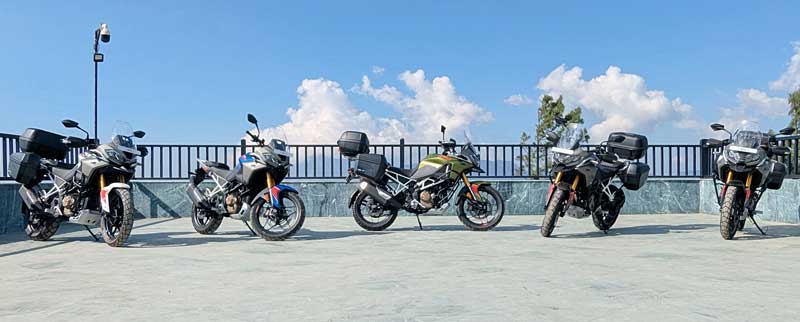
You can choose from five colorways: Viper Green (my personal favorite), Tarn Bronze, Metallic Blue, Lightning Black, and Pearl White. My favorite part, though? The rider triangle — it is more or less perfect for most sizes.
• Apache RTX 300 Global Pricing and Availability in the USA/ North America
What impressed me the most was the MSRP. The base variant starts at INR 199,000 (about US$2,250 at straight conversion), making it one of the world’s most affordable adventure tourers from a major manufacturer.
The top‑spec model as described here at INR 229,000 (about US$2,634) may vary slightly from TVS’ final “Top” and “BTO” price ladder in some markets, but the positioning as a value‑packed upper trim remains accurate.
The bike is already available for purchase in India, with deliveries expected to start very soon after launch. TVS has indicated that the RTX 300 will make its way to many of the 80‑plus countries where the brand is present. This means countries like Germany, Italy, South Africa, Argentina, Brazil, Colombia, Mexico, Turkey, Ukraine, Indonesia, Malaysia, the Philippines, Singapore, and Thailand are all expected to receive the adventure tourer sooner or later.
If the RTX is sold in North America, it would be through the Norton USA LLC which was incorporated November 2025 in Delaware as a subsidiary of Norton UK. At the time of writing, this is very recent and we expect it would take quite a while to establish brand and dealership network presence in the USA or Canada.
• Final Thoughts
The RTX 300 is about as easy and unintimidating as ADVs can get which is great for new riders and those looking to downsize. It comes with numerous features, including ride modes, a quickshifter, a slipper clutch, quality suspension, and a TFT display, plus options like cruise control and TPMS on higher variants. For what it offers, it undercuts the majority of its competitors in India, notably the KTM 250 Adventure, which is at least around INR 14,000 more expensive when you compare spec‑for‑spec against the upper RTX trims, even though the dollar figure is much smaller than the earlier US$1,230 claim.
TVS’ strategic partnership with BMW and the recent acquisition of British bikemaker Norton Motorcycles have done much to garner global interest, and it feels like the time is just about right for a new product to break through. With a slew of new options in the affordable, small-displacement ADV category it could be a challenging time to launch a new bike, but we certainly welcome more options and hope TVS does the Norton name justice by building a strong dealer network, honoring the brand’s heritage and ensuring long-term support around the world.
For more info on the new TVS RTX 300, visit the TVS site.
 Having over 15 years of experience traveling and documenting his adventures, Utkarsh Sood lives and breathes all things motorcycle. His quest to travel, write, and create films pushed him to quit his fancy advertising job to live life on his own terms. Or so he thinks. When he is not writing about bikes, he’s busy riding his trusted Royal Enfield Himalayan and creating content for his project ‘Silence & Stories‘.
 By
By