
Written by and Photos by Jay Kannaiyan. Posted in Rides
I woke up in my one-man tent covered in sand. The tent’s large mesh cover, acting as a sieve, had let in only the finest of desert talc sand that clung to my sweat. The sun had just risen and it was already extremely hot. But who cared? I was out riding in one of the most challenging places in the world, the deserts of Lake Turkana.
A few months earlier, as I plotted my route down the east side of Africa, I focused attention on the one stretch that is not yet paved. Northern Kenya is covered by a remote desert that extends from South Sudan in the west to Somalia in the east. It surrounds the massive inland desert sea of Lake Turkana, also known as the Jade Sea, for its emerald waters. The main route from Ethiopia into Kenya passes through the border town of Moyale and then opens up to a heavily corrugated road, infamous in the adventure motorcycling community for ruining suspensions. Riding 155 miles of that kind of road with sanDRina, my heavily-laden Suzuki DR650, was not an alluring prospect. All my worldly possessions were already straining her suspension. Luckily, a pair of Dutch bikers who had gone down the eastern side of Africa ahead of me had told me about a more adventurous, alternate route.

It was to be a grueling off-road journey that went from the Omo Valley of southern Ethiopia down along the eastern coast of Lake Turkana before ending at Maralal in the mountains of central Kenya. The off-road enthusiast in me was salivating as it considered the terrain and remoteness. To add to the challenge, there were no petrol stations for 560 miles.
This is one of the longest stretches between petrol stations in the world. For exactly these circumstances, I had installed the largest fuel tank available for the DR650 on sanDRina, the 10-gallon (38 L) Aqualine Safari Tank made in Australia to tackle its vast deserts.
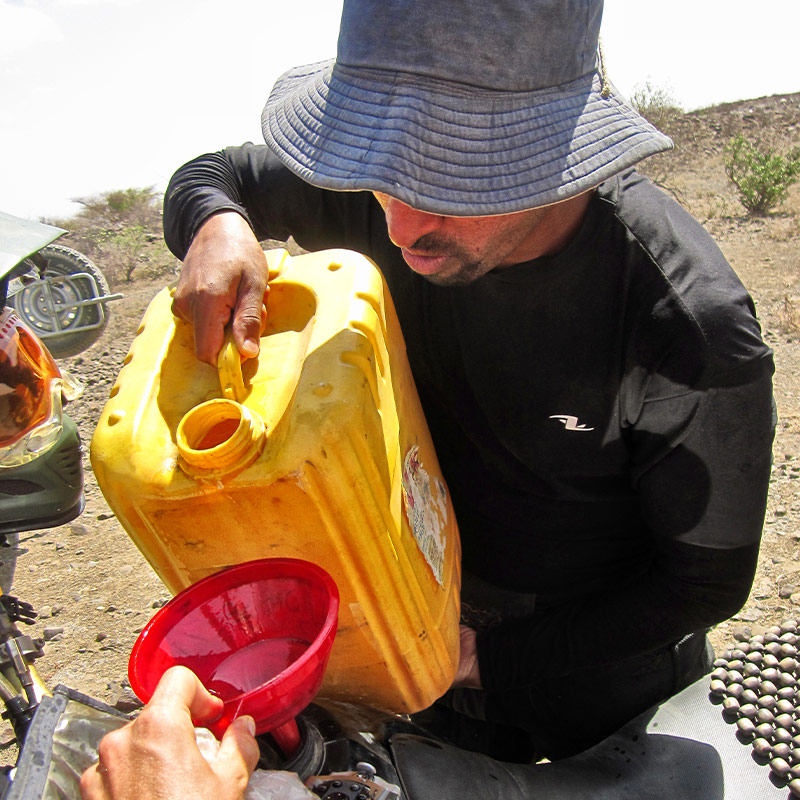
But even this was not going to be enough. In off-road conditions sanDRina consumes more petrol, reducing my range to around 300 miles as opposed to 435 miles on tarmac. I had to carry extra fuel and that meant finding other travelers—the four-wheeled kind.
Usually it’s difficult to coordinate among overlanders because of our varying speeds and schedules. Surprisingly, our convoy grew to five adventurers including Ferdi and Katie, a German couple, and their dog, Kayous, who were traveling in a VW Synchro 4×4 van; Guy and Lu, a young British couple in their baby blue Land Rover Defender; and Peter and Jill, an older British couple in their homemade Land Rover overlanding truck. And to keep it fun for me, there was Carlos, a biker from Spain on his KTM 640 Adventure.
All being independent travelers, to suddenly converge in this large group was unnerving. But we knew that in order to get through this difficult route we had to rely on each other. Descending from the Roof of Africa in the Ethiopian Highlands and leaving civilization behind, we filled our fuel reserves in the southern town of Konso before heading into the Great Rift Valley. As we drove farther into the valley the temperatures climbed as the highlands shrank, and greenery gave way to harsh desert tans.
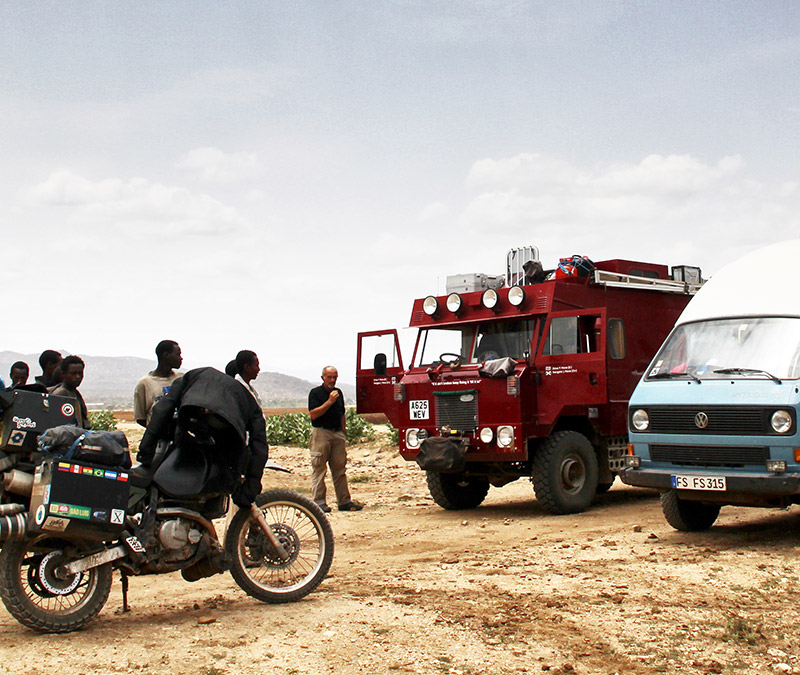
From Turmi, we detoured to the remote immigration post at the town of Omorate, the last sizable bit of civilization for several few hundred miles. At that point I promised Ferdi and Katie my special chicken curry that night in exchange for carrying five gallons of petrol for me. From a small, cramped shop on the side of the road we bought two live chickens and had a nearby hotel’s staff prepare them right in front of us, stashing the fresh meat in the cooler.
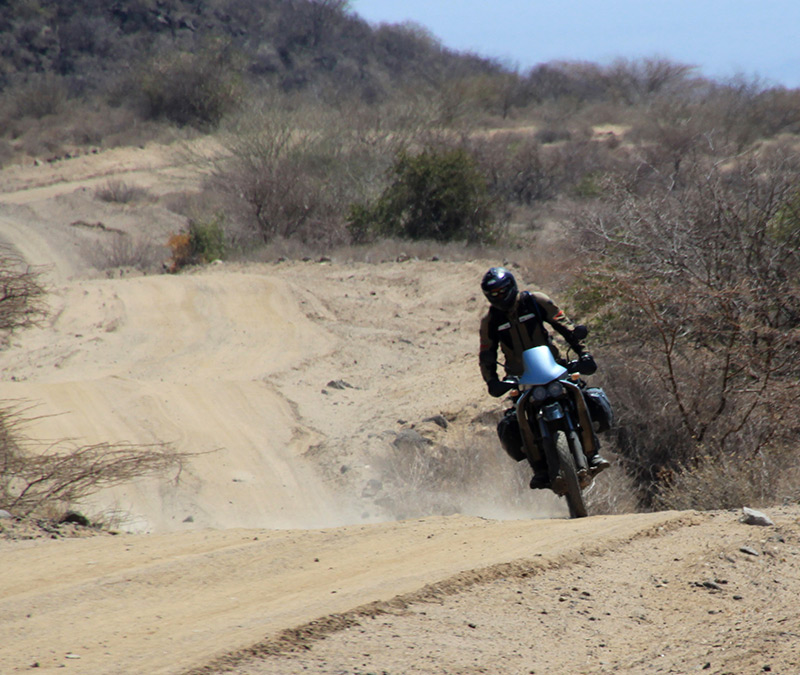
Rejoining our original route, the track degraded from a hard-packed gravel road into a two-track, sandy path that drove straight into thick acacia bushland. Thorns scratched my panniers and low-hanging branches forced me to duck. The Lake Turkana route is littered with about 30 water crossings, and we had timed it to be here at the tail end of the rainy season, ensuring our crossing without getting mired in mud. Before accelerating into the riverbed, I scanned ahead to the other side and chose my path before taking the plunge and swimming through the sand with sanDRina.
After a few hours of going in and out of riverbeds, I left the thick acacia bush of southern Ethiopia and my GPS showed me that I was crossing the border into Kenya. For all the tight security that is generally associated with crossing international borders, I smirked as I rode into Kenya without formalities. I thought about how artificial land borders are in reality, yet, how savagely they are defended by nation-states the world over. This was a no man’s land in the true sense. Forget about the bureaucracy of government, even the remote tribes that live around Lake Turkana were nowhere in sight.
But paperwork was lurking in the first settlement that we came across. In Illoret, a large village surrounded by fishermen making their living from the abundance of Lake Turkana, I received a letter from the stationed policeman. It stated that I had entered Kenya on this date with this vehicle. I was to produce this letter along with my passport at the immigration headquarters in Nairobi to receive my entry stamp into Kenya. That meant I would travel hundreds of miles into the country without a stamp in my passport. I hoped this letter would satisfy any prying officials.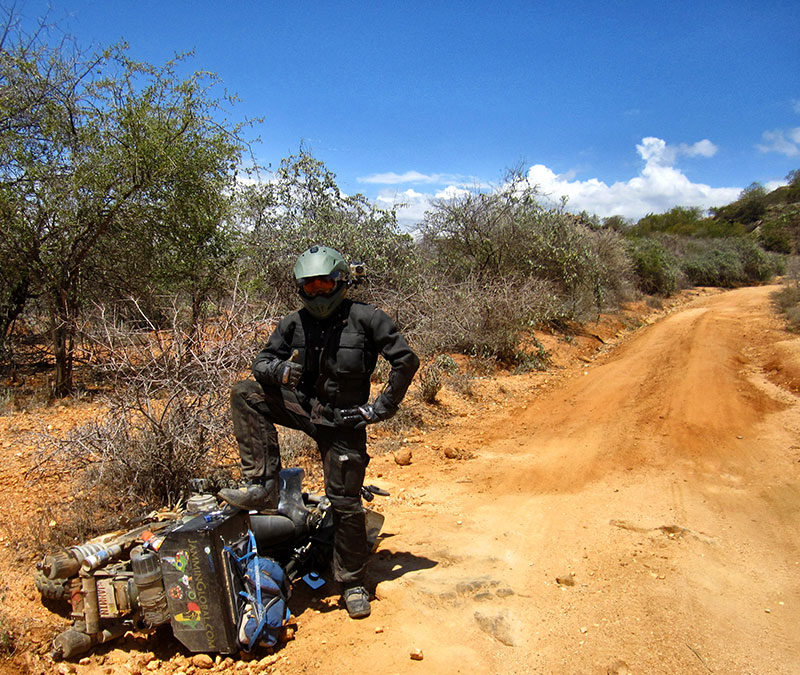
Our convoy left Illoret in a hurry to find a suitable camping spot before dark in Sibiloi National Park. From our last stop I turned inland where the track climbed up a craggy path covered in softball-sized volcanic rocks—standing on the pegs, charging up the path with good momentum.
Starting up the incline once again proved challenging as I had to slip the clutch heavily to achieve enough momentum to climb over a jagged surface. The riding was wearing me out and my shoulders were sore, but there would be no rest this evening—I’d promised to cook my curry!
We set up camp in a clearing with the lake in the distance. The sun had set and the respite in temperature was a relief, welcomed as much as Katie and Ferdi’s portable shower system. The making of our cultural dinner became a social event that brought our group closer together. I drafted everyone to help chop the tomatoes and onions that are so crucial to the curry’s scrumptious taste. I sweated it out in the back of Peter and Jill’s kitchen, cherishing this moment of cooking my curry in the deep wilderness of Africa. This dinner from the heart was wolfed down by all as Ferdi remarked that it was they who ended up with the good end of the deal. But as I drifted off to sleep smelling of garlic, and covered in sand with a wide grin on my face, I knew that the gift of sharing was the bargain of the experience.
While packing the next morning, I reflected on how the parched lands around Lake Turkana have preserved numerous hominid fossils over the eons, earning it the tagline of the Cradle of Humankind. Tribes still roam these parts and their culture wouldn’t be out of place if they were transported a few thousand years back in time. Alas, they won’t be left untouched by modern civilization for long. The fierce winds around Lake Turkana are a temptation for the wind turbine industry, and recently discovered oil under the desert is already attracting investment.
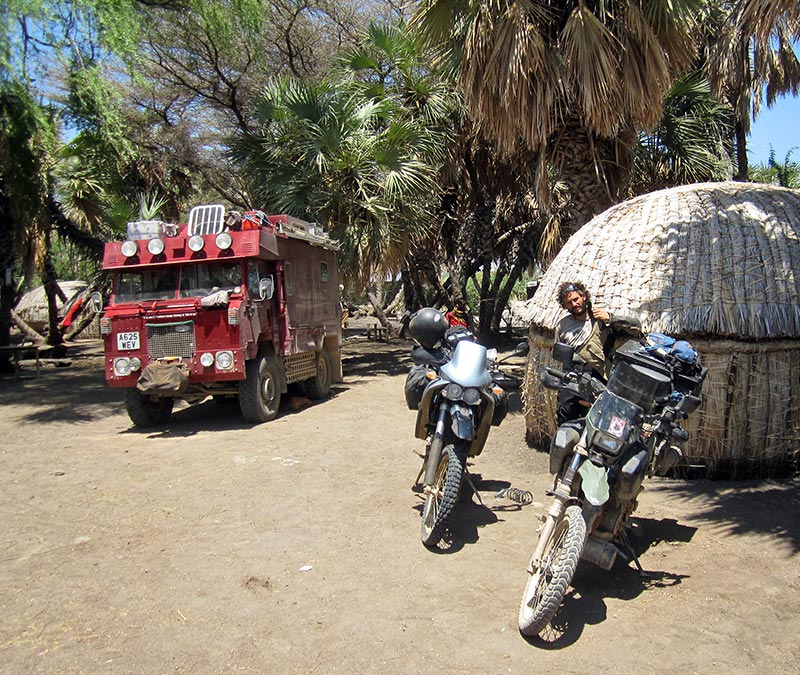
The journey continued through more sand and the father south we went, the firmer the ground became. By the next day we had reached Loyangalani, the largest village we encountered this side of the border. After a day off to rest our bones and the vehicles, the convoy continued south along the majestic lake. We soon left the desert behind, climbing back up the escarpment of the Great Rift Valley. The steep ascent had us riding rutted cliff roads all the way into Maralal, which signified the end of the Lake Turkana route as we had come across that ever-present marker of civilization, a petrol station.
The area around Lake Turkana has not changed for a very long time and that’s a rare find in today’s world. I felt like I’d gone back in time, but was very much present as I bounced on the ruts and felt the sand sucking at my tires.
What an adventure! There were challenging riding, exotic locales and my chicken curry! And even though the Lake Turkana route was the most challenging journey I’ve ever taken on, I rode away knowing that it took teamwork to accomplish my dream of riding in true African wilderness. Maybe that’s what it’s going to take to eliminate the borders of our nations in the future, as well.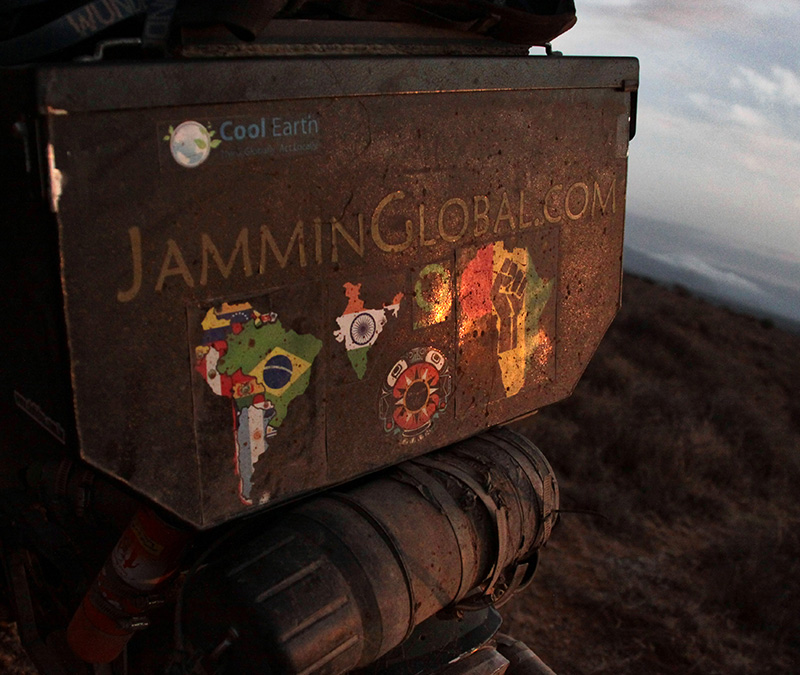
Jay Kannaiyan rode his Suzuki DR650 on a three year, 64,000 mile journey across 33 countries from the U.S. through Latin America, Europe, Africa and India. He’s now offering guided motorcycle tours through some of the best places he rode. More details at JamminGlobal.com.

 By
By