

Dealing with intrusive sound generated by engine vibrations, road surfaces and tyre noise has challenged manufacturers for decades.
Cars of the 1960s and 1970s carried kilos of extensive sounddeadening material in a bid to solve the problem.
These days, sound cancellation electronics have been used successfully in everything from headphones to cars and now ZF is adding to the technology with its Active Noise Reduction function for the chassis.
The new tech specifically targets tyre noise – one of the hardest sources of noise to deal with – using electronic cancellation.
Sounds from engine-related vibrations are predictable because they’re linked to each revolution of the crankshaft and the number of cylinders.
Sensors monitor the engine revs, and by the time the unwanted noise reaches the ears of occupants, a cancellation signal inaudible to the ear is transmitted through the infotainment speakers into the cabin.
The low-frequency booming caused by vibrating body panels can also be intercepted using microphones inside the cabin to detect the sound and a cancellation signal sent through the audio speakers in the same way.
Lotus Engineering was the first to demonstrate a system for cars to do both of these things, in the early 1990s. It chose a Citroën AX for the tests because it was one of the cheapest, lightest production cars at the time and had the minimum of physical sound-deadening material.
The results were spectacular. The flick of a switch when driving the prototype literally turned off the background booming sound generated in the standard car.
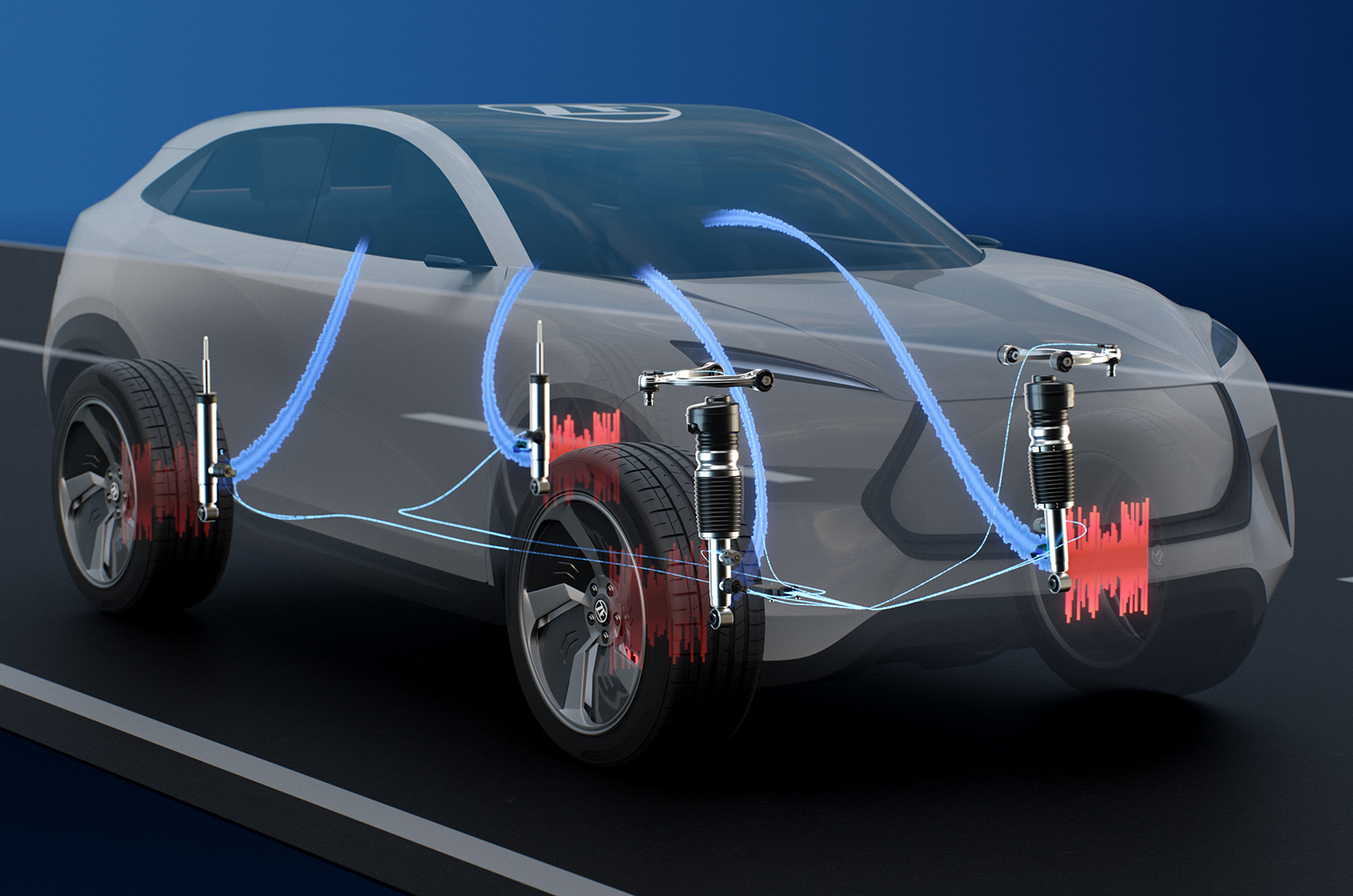
ZF’s system is software-based and uses the firm’s Smart Chassis Sensor with an integrated acceleration sensor to precisely measure vibrations transmitted from the tyres to the cabin via chassis components such as suspension control arms and dampers.
An algorithm recognises the characteristic noise patterns generated by tyre cavities, which typically sit at around 200Hz. Next, ZF’s CubiX chassis control platform software generates a counter-signal, which instigates ‘micromovements’ in the semiactive dampers to cancel the noise interference.
The movements are too small to interfere with the main function of the dampers, which is to dampen the vertical movements of the suspension, so handling and roadholding are unaffected.
The beauty of this technique, says ZF, is that none of the high-quality acoustic solutions involving microphones and speakers, typically available in only luxury segments, is needed to do the job.
Since ZF claims to be the market leader, supplying around 40% of all semi-active dampers fitted worldwide, this technology could potentially create a new market among lower-priced cars.

 By
By